

If you would prefer to listen to my presentation about this report, rather than reading it, I did a powerpoint presentation on my YouTube channel here:
Disclosures
I’ve been a paid user of Pangram Labs for a while and I like their product.
Pangram Labs gave me $80,000 in API tokens free of charge with no conditions and encouraged me to publish whatever I found regardless of the findings. They also sent me a hat, a bag, and some stickers.
I reached out to several other AI Detection/Classification companies to see if they were interested in participating in the study, most were not. GPTZero met with me and seemed interested but then stopped responding when it was time to give me access.
Before conducting the study, I registered my prediction on discord:


Abstract
There have been many concerns raised that AI detection software disproportionately identifies text by autistic authors as AI-written. This claim was assessed by using 24 different open-source and commercial AI detection/classification algorithms on samples of documents pulled from a pool of 143,758 documents from both autistic writers and non-autistic controls. Writing was taken from a variety of websites covering different writing types, styles, topics, and genres. Analysis of the data did not find meaningful or significant bias against autistic authors in AI detection software. Across most tests, human-authored autistic writing was either just as likely or less likely to be flagged as AI than both the non-autistic controls and publicly available benchmarks. In the very small number of tests that showed bias against human-authored autistic writing, the differences were slight or within the margin of error and came almost exclusively from unreliable detectors. Commercial detectors like Pangram 3.3.2 and 4.0, which are the most likely to be used for AI detection, showed no appreciable bias against autistic writing.
Introduction
Claims that AI text detectors are biased against autistic writers often arise in conversations about the ethics of AI detection software usage. These claims are typically sourced from a small set of studies, news articles, and social media posts, including the following:
A February 2024 paper, “AI Detection’s High False Positive Rates and the Psychological and Material Impacts on Students” by Whitney Gegg-Harrison and Claire Quarterman. That “presents the possibility that neurodivergent writers, along with L2 writers, are more likely to be impacted by false positives.”
A July 2025 paper, “The Misclassification of Autistic Writing as AI-Generated” by Summer Chambers and Matthew C. Kelly. This study used the OpenAI GPT-2 detection model to analyze 60,000 Reddit posts. They found that texts with authors identified as likely autistic were flagged more frequently than control texts representing general Reddit users.
A Bloomberg article that suggests “AI Detectors Falsely Accuse Students of Cheating—With Big Consequences” which explicitly states “Olmsted disputed the accusation to her teacher and a student coordinator, stressing that she has autism spectrum disorder and writes in a formulaic manner that might be mistakenly seen as AI-generated, according to emails viewed by Bloomberg Businessweek.”
An LLF National Law Firm article “AI Concerns for the Neurodivergent” which claims, “Anecdotal stories indicated that students who are neurodivergent were more likely to be accused of using AI to write papers” and “Students who are neurodivergent are more likely to be flagged as using AI tools due to linguistic or behavioral differences that relate to their disability.”
A New York Magazine article “The People Falsely Accused of Using AI Clean, precise prose is now a liability. Non-native English speakers and autistic writers are paying the price” which cites neurodivergence as a reason that writers flagged as AI.
Multiple Reddit, X, Bluesky, Medium, and Substack posts that claim that autistic writing is unfairly and disproportionally confused for, accused of, or flagged as AI writing.
A cursory search of several social media platforms found these claims to be quite common as shown in the figure below:
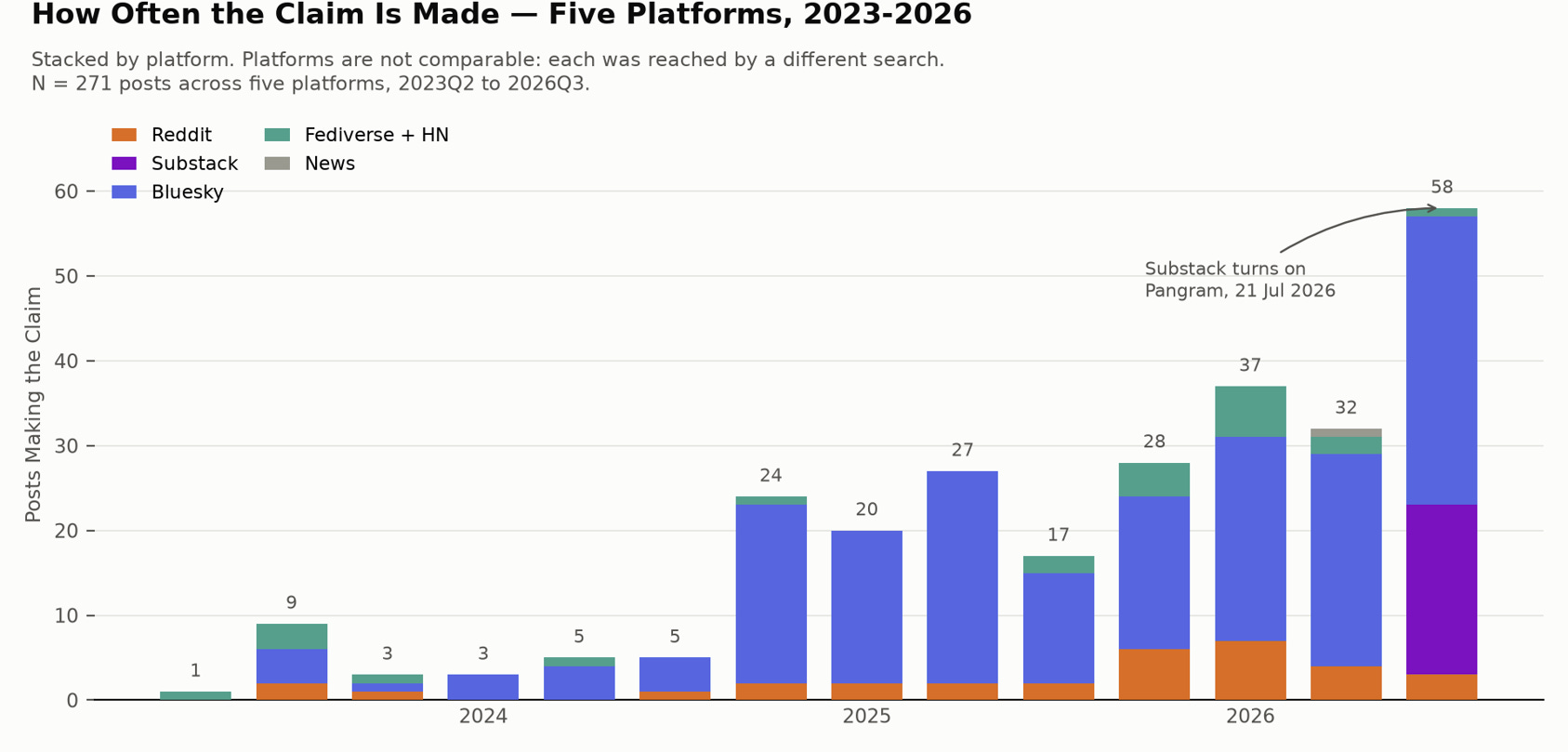
Figure 1 - Claims that AI Detection is Biased Against Autistic People
A subsection of these claims is shown here1:
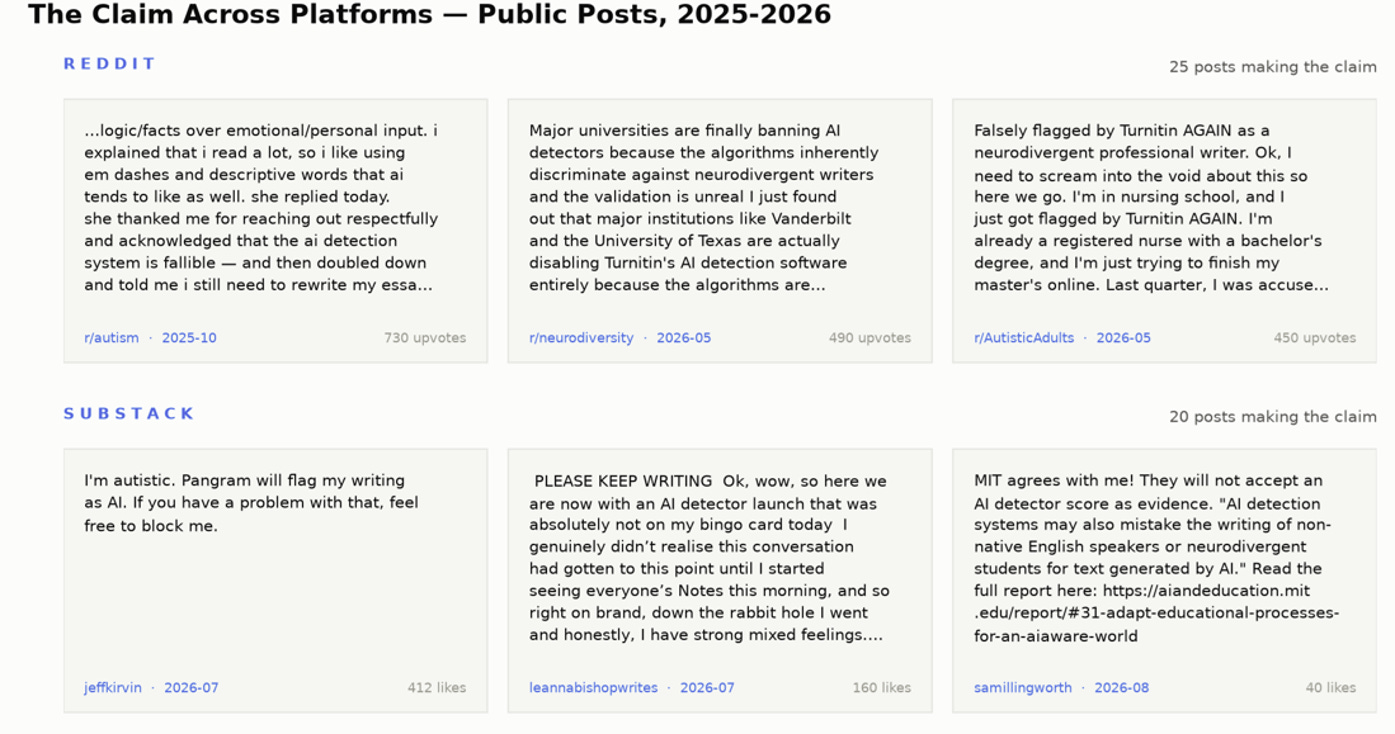
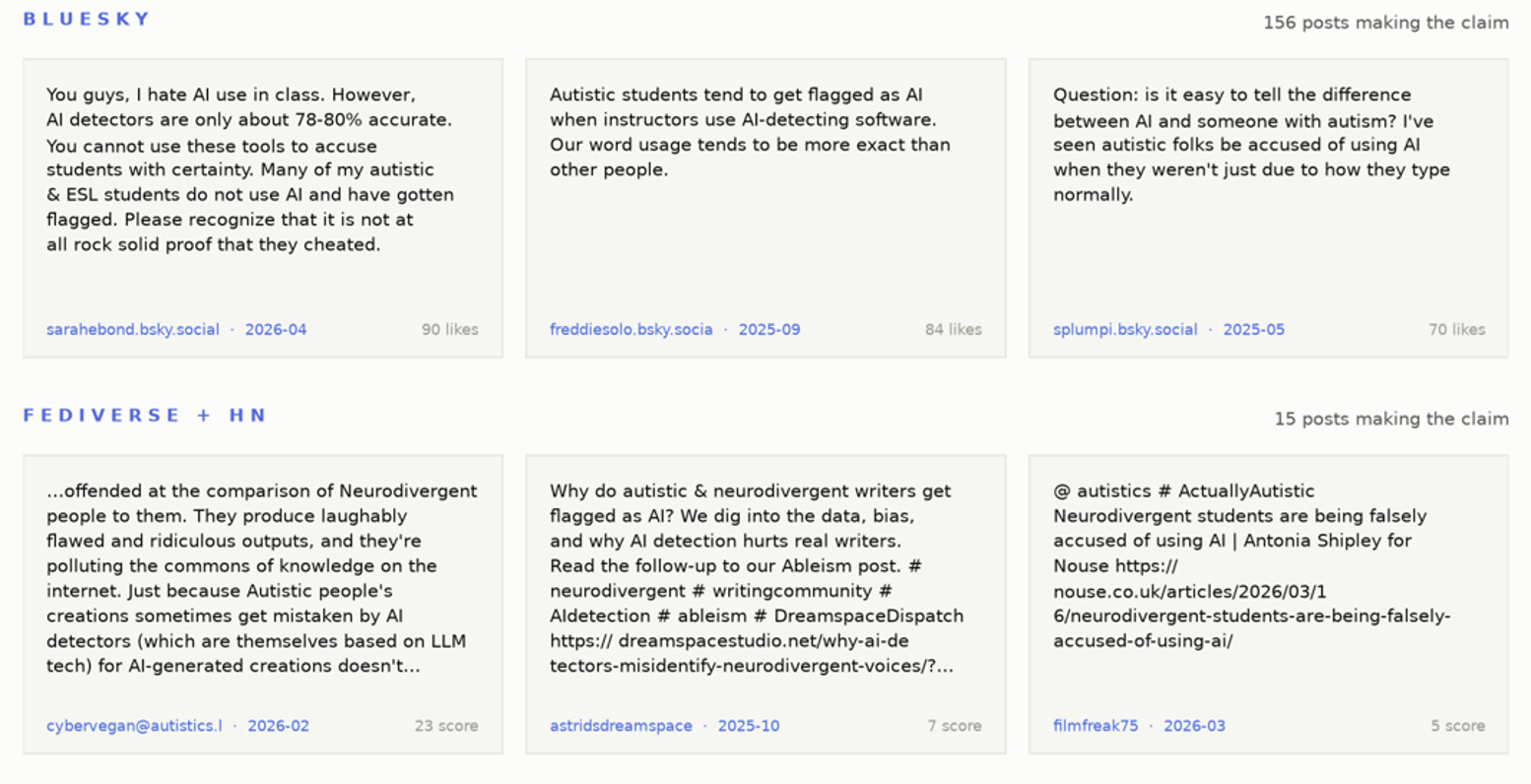
Figure 2 - Claims that AI Detectors are Biased Against Autistic People
If AI detectors disproportionately flag autistic writers, this is a matter of great concern for anyone who uses the software. This question is relevant to autistic people, academic institutions that use AI detection software, and the companies that build and develop AI detection software. AI detection tools are used specifically to determine if an author’s words are their own and to ensure the integrity and authenticity of writing. If AI detection software is disproportionately targeting genuine autistic writing, then academic institutions, hosting platforms like Substack, and enthusiastic users of AI detection software may be required to reconsider their use of these tools. If AI detection software does not disproportionately target autistic people, institutions and platforms that forgo AI detection software use over concerns of bias will be unnecessarily restricting the tools that they can use to verify and validate the authenticity of writing.
Most of the assertions about autistic writing being disproportionately and unfairly targeted by AI detection software are based on anecdotal evidence and difficult to verify. The studies that have found biases used older and now-obsolete detection algorithms like OpenAI’s RoBERTa GPT-2 detection model which was developed in 2019 to detect GPT-2 text. Whether AI detection software falsely attributes authentic autistic is an empirically testable question and can be answered with large data sets and access to the most current and up-to-date AI detection models.
This study it will specifically look to answer the question: “Are modern AI detection methods more likely to generate false positives on writing by autistic people?”
Methods
The purpose of this study is to determine whether authentic autistic writing gets disproportionately flagged as AI generated when compared to non-autistic writing. In order to determine this, this study considered four data sources. These sources were broken down into two arms, an autistic and control arm, each of which was additionally split into their pre and post 2022 era. The four data sources were:
Pre-2022 Autistic Writing (2009- 31 Dec 2021)
Post-2022 Autistic Writing (1 Jan 2022-Present)
Pre-2022 Non-Autistic Writing (2009- 31 Dec 2021)
Post-2022 Non-Autistic Writing (1 Jan 2022-Present)
The year 2022 was chosen as the epoch the release of ChatGPT to the public in that year enabled the widespread access to LLMs. Texts written prior to 2022 are far less likely to have used generative AI in their production than texts written after 2022.
An additional data source considered for the study were published AI Detection Software Benchmarks from independent third-party reviews and other papers.
Data Collection Criteria
Data considered for analysis had to meet the following criteria:
Over 500 Words – AI Detection software accuracy is often significantly reduced under 500 words. The figure usually cited for minimum viability is 300 words. To ensure that results were not contaminated by noise resulting from samples that were edging on minimum viability, a floor of 500 words was chosen for this test.
Clear Publishing Date – The writing had to have some sort of verifiable date or publishing and timestamp. This included modification timestamps if applicable.
User/Post Association – Texts were taken from forums with a clear association of users to posts, enabling reliable identification of autistic authors in posts not specifically mentioning autism. Anonymous forums and forums without traceable user search/tracking were not used.
Source Identification
Autism Source Identification
The following search mechanisms were used to identify writing by autistic authors:
Blind Regex Search - Web application search using a wide variety of autism related key words. This was done using two techniques:
In application search features that allow for keyword and tag search.
Blind bulk collection from social media followed by a regex sweep.
Autistic Community Association – Autism-specific forums, sub-forums, and blog topics were searched for autistic users’ posts about autism and related topics. This included autism-specific forums, websites, substacks and blogs.
Autism-Saturated Hobby Spaces – Spaces known to have a high saturation of autistic engagement were searched for autistic authors and writers.
Association Spidering – Where you find one or more autistic people, you are likely to find quite a few more who do not show up in initial sweeps. The above sources as well as topics, blogs, writers, news events related to autism, and media frequently consumed by autistic people were selected as initializing nodes for an association spider search. The potentially autistic users were then selected by analyzing various post engagement metrics like public likes, reposts, quote posts, comments, tags, and references. These users were checked for autism self-identification, and then recursively searched for additional autistic followers. These nodes were recursively searched to a depth of 40.
Control Source Identification
A control group was selected using the same algorithmic scraping and identification techniques. Regexes could not be used to identify control users but were used to exclude potentially autistic people from the control groups. These users were searched to ensure that they did not have any signals associated with autism profiles. The goal when selecting control groups was to obtain writing in a similar genre, from similar sources, and with similar writing conventions as the samples by autistic authors to determine if the closest equivalents to autistic writing would be more frequently flagged than non-autistic writing. Control websites, genres, and writing samples were collected after autistic writing to attempt to ensure a rough parity could be established.
Forums, boards, and topics that tend to have higher concentrations of autistic people were avoided for control texts to prevent contamination from non-disclosing and undiagnosed autistic authors. Attempts were made to find representative genre- and topic-matched controls where possible. Specific controls could not be found for some sources specifically catering to autistic topics with no non-autistic analogue, such as lesswrong, Slate Star Codex, Aspie Central, and Wrong Planet. These communities have high baseline autism saturation, so collecting users who did not disclose an autism diagnosis still held a very high chance of control contamination. Other neurodivergent conditions that have high overlap with autism, like OCD and ADHD were also excluded from controls. Some communities that were not expected to have significant autism saturation and overrepresentation, like general interest Reddit topics, were sampled for both autistic and control authors.
Controls for this analysis were defined as “Users who showed no signals that could indicate that they have autism.” It is possible that autistic people who are undiagnosed or otherwise gave no indication of being autistic were accidentally included in this data set because they exhibited no autism signal.
Identification Criteria and Scoring
Autistic author scoring
Once an autistic author was discovered, they were confidence scored between 0-10 based on a constellation of these contributing factors. While the scoring method used could result in scores above 10, this result was capped due to a high level of certainty already being reached. The cut-off threshold for this study was 5. The main factors chosen for identification were:
Self-disclosure – Users said in a social media bio, forum tag/flair, comment, post, podcast, book, news story, journal article, or other media that they had autism. Multiple disclosures across additional documents increased the score count. This was done to account for people who denied they had autism, were diagnosed, and then disclosed their diagnosis. Disclosure statements were split into 6 categories:
Certain – User says something like “I am autistic”, “As an autistic”, or uses the hashtag #Actually autistic. 1 Point per disclosure.
Screener score above threshold – User posts a score from an autism screener and that score is higher than the screener’s threshold. 1 Point per disclosure.
Tagged – User uses a flair, tag, badge, bio, or belongs to an opt-in autism group. 1 Point per disclosure.
Hedging – User says something like “I think I’m autistic”, “I’m a little autistic”, “I’m mildly autistic”. 0.5 points per disclosure.
Questioning – User says something like “I am thinking about getting evaluated for autism.” 0.5 points per disclosure.
Denial – Without any later identification, phrases like “I do not have autism” were automatically set to -1.
This category was capped at a maximum score of 5.
Verified in Official Sources – Lists of known autistic writers were pulled from various high reputation sources, like trusted news sources, publisher information, official press releases, and company bios. This was a binary category that would score 5.
Online Autism Community Participation – Engagement with online autism communities would also increase score. It is very possible for someone to engage with an autism forum and not be autistic, so this category was capped at 2. Engaging with popular autism communities and accounts were weighted lightly (0.1 per unique account/community interaction) while less popular and more autism specific forums (e.g. legacy autism forums such as Wrong Planet and Aspies Central) were weighted twice as heavily.
Listed in unofficial sources – Autistic people listed on Wikipedia lists, Goodreads lists, blog aggregators, and other community lists of autistic authors. This was a binary category that would score 3.
Manual Verification with the Researcher – The autistic person confirmed to the researcher that they had autism (either verbally or in writing). This category would score 10.
Control Scoring
Controls were negatively screened against the same identification criteria used for autistic people. Instead of a score from 0-10, any hit in any category disqualified them from participation in the control group.
Author Exclusion
Before text was extracted and examined, the authors were scored and then rejected or accepted into a group. This was the pre-collection sweep. The below tables show autistic authors collected in the initial sweep and how many were pruned from the data set because they did not meet scoring thresholds.
Prolific Author Capping
It is possible for a single author to accidentally come to dominate a data set; author caps were generally set to a maximum of 40 documents per author. This cap was placed quite high because it is easier to lower the author cap than to raise it in post-analysis. 2% of authors hit this cap. Some of these caps were lifted for collection on sub-communities where data was sparse. Authors were also tagged per document to ensure that in post-collection analysis, any author selection skew could be accounted for and mitigated in post-processing.
Data Cleaning
Prior to submitting data for AI Detection analysis, data was cleaned to remove any lingering collection artifacts that could cause issues with detector accuracy. Cleaned and raw versions of the data were both kept and compared to ensure cleaning did not have an unintended impact on results. Data cleaning was intentionally conservative and was done to ensure text legibility and that only the words of the author themselves were being analyzed. The largest thrust of data cleaning was not text correction, but data-deduplication and text suitability analysis. A 500-word analytic floor was computed after cleaning to ensure text suitability, with texts below 500 words excluded.
The following techniques were applied:
HTML and Formatting Artifact Removal – HTML tags and artifacts, unescaping, zero-width characters, and line-ending whitespace were removed.
Non-attributable Authorship – Posts where further analysis did not find a linked or attributable author were removed.
Encoding Repair – Samples obtained from sources using different text encodings and formats were normalized.
Markdown and Rendered Prose Removal – Markdown and related symbols were removed prior to submission.
Boilerplate – Boilerplate, pro-formas, signature blocks, and other format-structuring artifacts were removed so that only the user’s intended message was captured.
Inline Insertions – Inline ads, subscribe buttons, newsletter sign ups, links to outside websites, and similar unoriginal embedded content were removed.
Extraction Artifacts – Multi-tweet/comment threads were stitched together, and similar text formatting artifacts introduced by the collection process were corrected.
Language Screening – Non-english posts or majority non-English posts were removed from the data set.
Deduplication – Exact SHA-256 and MinHash (Jaccard > 0.8) sums were taken of each sample to avoid duplication and double-counting.
Quote Heavy Exclusions – Documents containing large numbers of quotes, pull quotes, and text sourced from elsewhere were excluded from the data set.
Code Heavy Exclusions – Documents containing large amounts of computer code (e.g. inline CSS/JS) were excluded from the data set.
Marketing Exclusions – Spam, marketing, publisher blurbs, and corporate press releases were removed from the data set.
Spam/Repetition Exclusions – Documents that met the 500 word count threshold but largely contained repeating phrases or nonsensical text were removed.
Copypasta Exclusions – Forums often contain memes/inside jokes/copypastas, which were fuzzy-matched and excluded.
Datetime Extraction – All timestamps were removed as a precaution against models that use time creation hints to score AI/human writing.
Edit Risk Exclusion – It would be possible for someone to use AI to edit a sample written pre-2022 long after the fact. Although this is unlikely, documents that had an edited or edit timestamp post-2022 were excluded; documents with an edit artifact without a timestamp were excluded.
Control Author had Neurodivergence Signal Missed in Pre-Filtering Sweep – To ensure that controls did not accidentally contain a neurodivergence signal that could indicate they were autistic that was missed in author pre-filtering, a post-filtering sweep was run on all collected control data to ensure they contained no neurodivergence signals.
I wrote the documents – Because I am both autistic and write a lot, my scrapers found and picked up my own writing, which I removed from the corpus to avoid any unforeseen conflicts of interest. Rest assured I scanned all my writing with Pangram 3.3.2 and 4.0 and it found no AI.
A list of document exclusions and why they were excluded is included below. Note that the neurodivergence signal listed here is a post-processing detection of a neurodivergence signal. Signals were analyzed pre- and post-collection to ensure that autistic data did not land in controls.
Document and Author Exclusion Breakdown
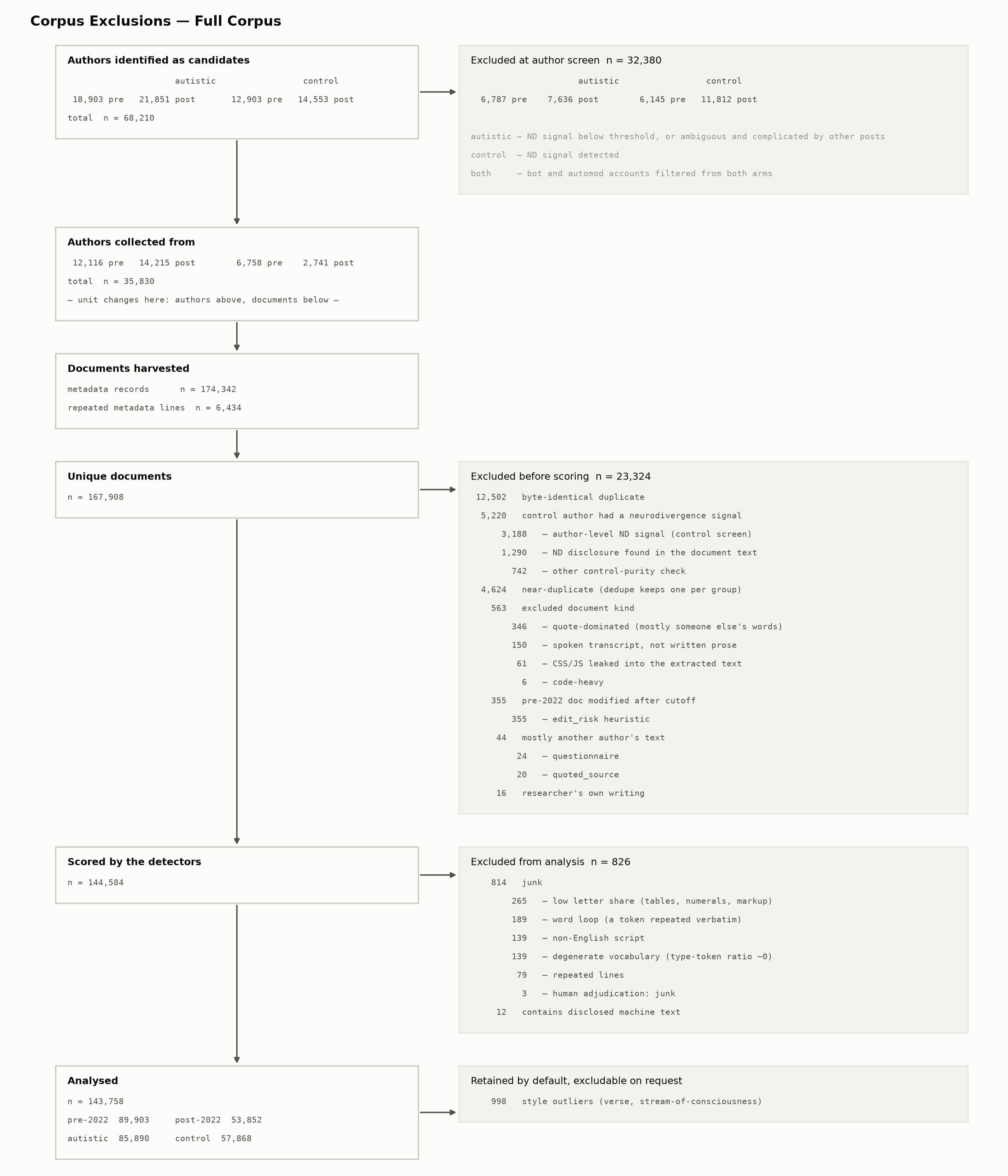
Figure 3 – Author and Document Exclusions by Reason
Document Cleaning Breakdown
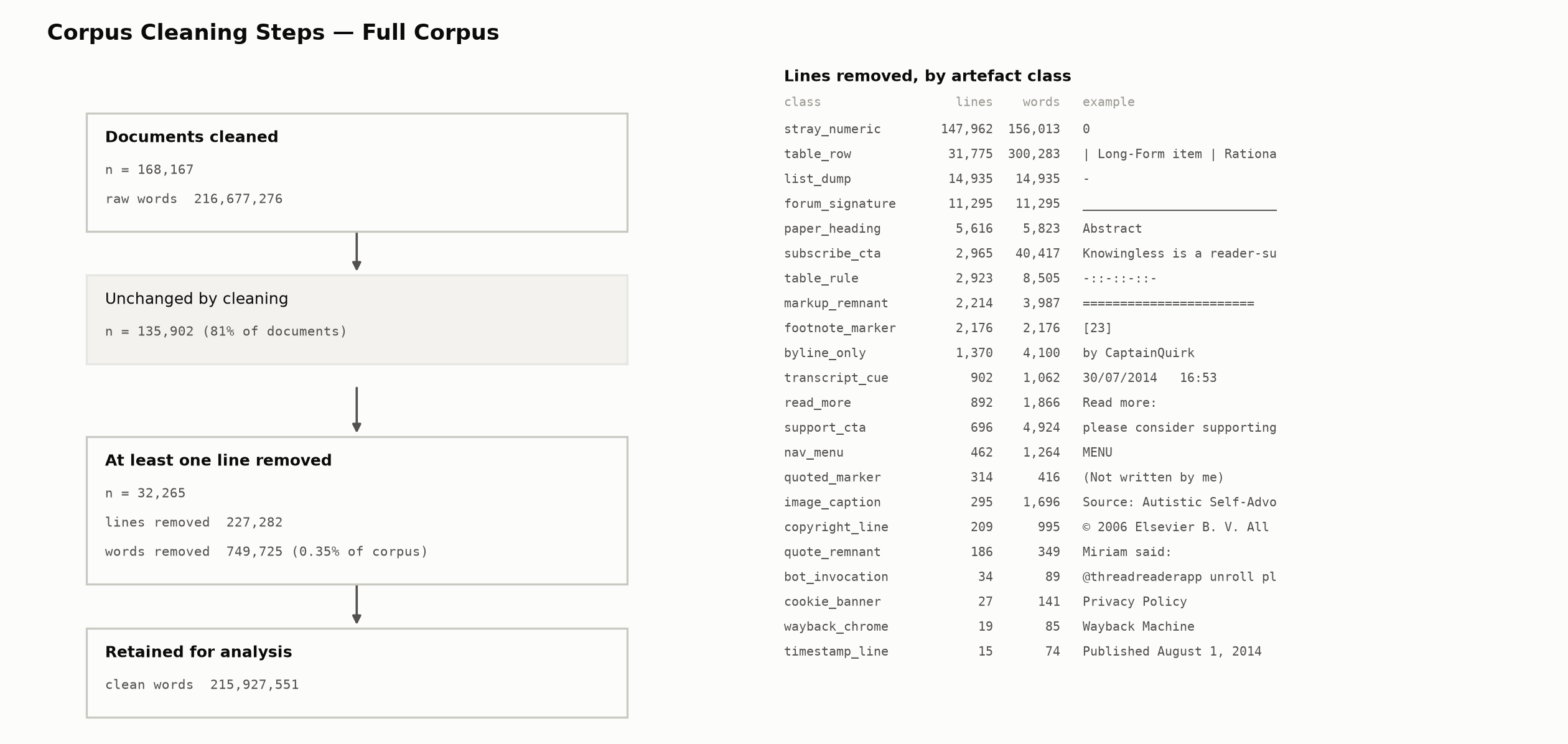
Figure 4 - Data Cleaning Overview
Document cleaning and removal happened in phases, so some documents were cleaned and then excluded.
A representative sample of 1439 cleaned and raw documents was submitted to the full complement of AI Detection software to verify that cleaning did not have a meaningful effect on detection. Results for all raw and cleaned documents were nearly identical. In the cases of reliable detectors, results were identical.
Testing was done on clean vs raw data on every classifier to check to verify whether cleaning had any discernible effect on results. Across classifiers, cleaning had no meaningful effect.
Data Collection Limitations
False Positives – Search methods produce a false positive identification rate of between 2-5% depending on the community they are being used to assess. These methods will often pull up bots, auto mods, novelty accounts that repeat quotes from other users/copypastas, and fan fiction containing fictional autistic characters. In many sub-communities, “autism” or “autistic” are used as self-deprecating jokes, shorthand for obsessive or awkward, or as a term of endearment for someone putting in a lot of sincere effort. False positives in journalism, professional writing, and other fields were negligible because identification methods required explicit autism identification on public figures. For anonymous social media and forum users that made up most of the data set, post-processing document analysis and exclusion place the rate of FP at around 3-9% for controls (5220/53852 control documents were removed in post-processing after a potential neurodivergence signal was found in the data that was initially missed in collection). False positives for autistic writing were around 2-5% (1631/58590 documents were rejected post-collection because of clear non-human authorship (such as a bot or automod) or a weak neurodivergence signal that was artificially over counted).
No Demographic Data – User data enrichment and enhancement was not performed on any authors. User data can be mined for clues like gender, age, location, relationship status, family structures, etc. This data set was designed to be shared with other researchers, so in the interest of privacy, these additional analytics were not deployed to ensure most demographic information is not available and cannot be reliably determined with the available data set.
Bias Towards Self-Disclosure – The data set is biased towards the types of people who openly self-disclose autism signals. Many autistic people do not self-disclose autism; this group of autistic people would be invisible to these data collection techniques.
No Differentiation Between Self-Diagnosed and Clinically Diagnosed – In many online autism communities, self-diagnosis is considered just as valid as a diagnosis from a clinician. The methods used for data collection could not reliably establish differences between diagnosed and self-diagnosed autistic people because both categories register similar autism signals. On occasion users would specify self-diagnosed and clinically diagnosed statuses but they did not do this at a rate that is common enough to reliably establish pools.
English Only – Collection was done on English only groups.
Bias Towards Autism-Saturated Communities – Collection was biased towards communities known to have high autism saturation to facilitate collection. Other communities which contain autistic people but without well-documented autism saturation were skipped in the interest of time. Further longer term/duration studies can rectify these issues.
Conservative Criteria – Scoring and identification were done with the intent to remove false positives, which meant inclusion required explicit self-declaration and identification.
No Student Writing – Many of the claims about AI detection/plagiarism were from student writing specifically, which I could not collect with reliable autistic identification or controls for my sampling methods. Formal writing, polished writing, essays, and long form writing were all considered in the sample sets which provide close proxies to student writing.
Ethics and Data Safeguarding
The following protocols were put in place to ensure fair and ethical collection and data usage:
User Identity Protection – Raw Usernames were not collected or stored. User identification was tracked by salted SHA-256 hash so that username reverse lookup was not possible.
Only Plaintext submitted to LLMs – Only the raw data created by the user was submitted to online hosted detectors. URL, source, usernames were not submitted.
No Data Training/Reuse – AI Detection platform data usage policies were carefully analyzed to ensure that submitted data was not kept, stored, or used/re-used for training and publication.
Collection Conduct – For this experiment, I did not attempt to bypass paywalls, captchas/botwalls, or ratelimiting. All requests were sent with a user-agent string containing my email address and clearly identifying who I am.
Data Tagging
Data was sorted and tracked by tags. Tags were used to track trends across sub-communities, topics, and milieus.
Data was tagged by date first published and last edited (if available)
Data was tagged by milieu and genre. These categories were determined with scoring and weighting derived from several categories. Categories were pre-established before collection; each piece of content was scored positively or negatively against each category by exact and fuzzy match. Each match was scored as +/- 1 and the highest category score won for the tag applied to the text considered were:
Text Source – The website that the text was found on was scored against each category and given higher scores for closer fits.
Category self-description – How the website/blog/forum describes itself was scored against each category and given higher scores for closer fits.
Forum topic if available – If the website had a forum/board structure, the board name and description was scored against categories.
Post tags if available - If the website supported tags, tags on each post were scored against categories.
Text content keywords – Regex sweeps per category looked for keywords and phrases and scored against categories.
Comments – If the post had a comments section, comments were analyzed with the same regex set and scored against categories.
Analysis Methods
Once the corpus was collected, the data was analyzed by 24 different AI detection models of various types. All models were fed the same raw text. The following AI Detection algorithms were used for analysis:
Trained classifiers — GPT-2 era (2019)
RoBERTa-base
RoBERTa-Large
Trained classifiers — early ChatGPT era (2023)
chatgpt-detector-Roberta
Trained classifiers — modern era (2024–25 training data)
e5-small-lora
RADAR (RoBERTa-large, adversarially trained vs paraphrase)
MAGE (DeBERTa-v3, cross-domain academic)
desklib-detector (DeBERTa-v3-large, single-logit head)
Zero-shot statistical
Fast-DetectGPT
Binoculars
LLM As Judge
Open AI
GPT-5.5
GPT-5.2
GPT-5.4-mini
GPT-5.4-nano
o4-mini
GPT-4o
Anthropic
Opus 5
Sonnet 5
Haiku 4.5
Fable 5
Self-hosted open-weights judges
Llama-3.1-8B-Instruct
Qwen2.5-14B-Instruct
Mistral-7B-Instruct-v0.3
Gemma-2-9b
Commercial Tools
Pangram 3.3.2
Pangram 4.0
Windowing and Piecewise Document Analysis
Local AI Detection Software Classifiers
Some classifiers had an architectural limitation that limited the amount of text that could be analyzed. To mitigate this and ensure full text coverage, a sliding window token analyzer was built to break documents into 512 token chunks so that the entire document could be analyzed.
If there were multiple windows the cumulative results were analyzed with various rules to ensure that text chunking did not artificially change results. All rules were evaluated on every windowed data set. Best rules were chosen by how well the detectors performed on a set of known true positives (Pangram 4.0 anchored) and false positives on pre-2022 data.
Analysis rules were:
One hit
Mean Confidence
Šidák-corrected max
Matched-FPR rule comparison
Length-stratified reporting of the autistic/control gap within n_windows bins
Top-k mean (e.g., mean of the 2 hottest windows)
Consecutive-run rule (≥2 adjacent windows over threshold)
Fisher / Stouffer p-value combination across windows
Overlapping windows (stride 256)
Pangram Per-Segment Documentation
Some detection tools provide a per-segment document analysis. Pangram, for example, provides an overall document judgement and then a per-window analysis. Per-window analysis was treated as separate for judgement purposes
LLM Per-Segment Analysis
LLM Judge analysis needed to be limited and truncated due to compute and token constraints. Documents for segment analysis were capped at 20,000 words.
Documents were truncated and then split into segments based on paragraph/sentence delineation. These segments were capped at 2,400 characters and run across the full documents. The segments were then individually judged with an AI verdict and human verdict with a confidence level for each. AI vs Human judgement was based on an analysis of p(AI) vs p(Human).
Benchmark Validation
To ensure tools were functioning as they should, all of the detectors and their published data sets were run through an identical testing pipeline, and rates of false positives and true positives were validated against published benchmarks. Tools were additionally benchmarked against their own published data sets where available, and false/true positive/negative rates were assessed against published benchmarks. All benchmarks were successfully validated with their testing data where available.
Benchmarks
Two categories of controls were used for this survey. The first were published detection tool benchmarks. These benchmarks established the base-rate of false positive AI identification and were one of the metrics against which the claim “Is genuine autistic writing more likely to be flagged as written by an AI?” was made. Benchmarks were not available for all tools, especially LLM as judge tools.
LLM as Judge
An anticipated use case for AI detection that does not fall into strict AI classification territory is LLM as judge. This is a case in which classification is not conducted using a tailor-made AI text classifier but instead uses a modern frontier LLM to evaluate text for AI characteristics and features. Anecdotal reports taken from Reddit by autistic writers claiming autistic bias in AI detection describe a scenario in which a professor or teacher submits their text to a frontier LLM and asks the LLM to determine if it was AI- or human-generated. This was a complaint that showed up so frequently that it warranted testing even though it doesn’t meet conventional AI classification expectations. Minimal guidance was given to each LLM, “Use your own judgement” was used instead of explicit instructions in identifying AI text in every situation except the partial AI analysis where the prompt “Look for seams: shifts in voice, register, structure, or specificity.” was added as additional guidance due to model confusion about what partial AI text meant, and to mitigate issues found in initial testing. This methodology was used to simulate as closely as possible the scenario of a professor or teacher sending a document to a frontier LLM for evaluation.
LLM as Judge Limitations
Experimentation Budget Constraints
For testing LLMs, due to compute and budget restrictions, the full corpus could not be tested. Testing the full corpus of the text would run an estimated $12,000 in API tokens, and my budget for API tokens for this secondary test category was limited to $300 for API access and my weekly Claude Max Pro 5 and ChatGPT pro token budgets.
Full LLM Large Analysis
Due to both hardware and budget limitations, I restricted document analysis of LLM as judge to the first 700 words of each document. These first 700 words were used specifically to adjudicate the human vs AI judgement. This was done to ensure that processing could be done in a reasonable length of time and within my hardware and budget constraints.
Partial LLM Large Analysis
When analyzing documents for partial AI usage, the texts were truncated to 20,000 words and broken down into chunks along paragraph breaks or 2400-character capped chunks.
Text Truncation Constraints
To ensure that this truncation did not seriously affect results, the documents that were truncated (around 5600) were pooled. I ran a smaller limited run that randomly sampled the untruncated versions of the documents and analyzed the differences in confidence intervals and how many documents flipped from AI to human and vice versa. Across models, flips were very rare and flips in both directions (AI->human and human->AI) happened at roughly the same rate across models (<1.5%). This meant that truncation did not have a meaningful or significant effect on LLM as judge verdicts.
Sampling Constraints
Due to budget constraints, LLM as judge tests need to be run on a sample set.
Two ways of sampling were considered:
Proportional Sampling – Data sampling is done to accurately reflect exact proportions of data in samples by genre, year, or milieu. In this sample, if source A made up 40% of the data set and source B made up 1% of the data set, the sampled set would include 40% of A and 1% of B. This sampling method preserves the shape of the data set, while squashing smaller sources.
Weighted Sampling – Data sampling is weighted to ensure effective coverage of all genres, years, and milieus rather than proportionally sampled. In this sample, A could end up only being 20% of the data set and B could make up to 5%. This sampling method preserves the communities and breadth of sampling while sacrificing the overall data shape.
Weighted Sampling was chosen for this to preserve the different genres of types of writing rather than the overall shape. Corpus diversity was more important for this test than corpus proportional shape.
Model Data sets
To facilitate the LLM as judge testing, two data set were created that were specifically sampled to give an accurate, representation of the larger data set.
LLM Large – 12,000 randomly sampled documents, consisting of 3000 autistic pre-2022, 3000 control pre-2022, 3000 autistic post-2022, and 3000 controls post-2022.
This data set was used as the comprehensive coverage set. Post sampling analysis ensured that documents flagged as AI by other detectors were in all data sets.
Models evaluated against LLM Large:
OpenAI judges:
GPT-5.5
GPT-5.2
Anthropic Judges:
Opus 5
Sonnet 5
Haiku 4.5
Self-Hosted Open-Weight Judges:
Llama-3.1-8B-Instruct
Qwen2.5-14B-Instruct
Mistral-7B-Instruct-v0.3
LLM Small – 1,200 randomly sampled documents, consisting of 300 autistic pre-AI era, 300 control pre-AI era, 300 autistic post-AI era, and 300 controls post AI era. This data set was used to spot check older, smaller, or more expensive models rather than performing a comprehensive representative analysis.
Models evaluated against LLM small:
GPT-5.4-mini
GPT-5.4-nano
GPT-4o
o4-mini
Fable
Two methods for evaluation were used:
Single Text Analysis – One text was sent to the LLM to judge independently with no context.
Batched Analysis – Groups of 25 texts were sent to the LLM to judge as groups.
Batching Composition Analysis
LLM analysis of batching could bias results of the detector. Batching analysis was conducted on 1200 documents, 468 known AI generated and 732 known human texts. These documents were analyzed by each LLM as judge in various combinations:
AI Generated Documents only
Majority (80%) AI Generated Documents
Slight Majority (60%) AI Generated Documents
Near even Split AI and human (52%) AI Generated Documents
Slight Minority AI text (40%) AI Generated Documents
Minority (20%) AI Generated Documents
No AI Generated Documents
Thirty batches of combinations of each of these with known AI and known human texts combined in various clumps were tested against each LLM to see how batching biased documents. No meaningful bias was found with any combination of batching.
Prompts used:
Various prompts were created and tested against a small sample of known AI generated texts and known human generated texts. Prompts were created by hand, by prompting various LLMs and by finding other similar prompts in research papers. The best and most effective prompts were created by describing the testing methodology to Claude’s Fable and getting it to design the prompts.
These texts are verbatim what Fable generated and what was used for testing LLM as judge.
This portion of the report was actually written by AI, you can check the Pangram Labs accuracy by running the AI scanner against this report, this segment should flag if it is working. Human text starts again at Detection Rates
Prompt 1 – Single Text Analysis:
Below is a text excerpt. Judge whether it was written by a human or generated by an AI language model. Use your own judgment only.
Respond with ONLY a JSON object, no other text:
{”verdict”: “Human”, “confidence”: 0.9}
verdict is exactly “AI” or “Human”; confidence 0.5-1.0.
Prompt 2 – Batched Analysis 1:
Batch-of-25 form (GPT API judges, and the local -b25 experiment, from score_local_judge_batch.py — the JSON array of {”id”, “text”} objects is appended):
Below is a JSON array of text excerpts, each with an “id”. For each text, judge whether it was written by a human or generated by an AI language model. Use your own judgment only.
Respond with ONLY a JSON array, no other text:
[{”id”: “d0”, “verdict”: “Human”, “confidence”: 0.9}, ...]
verdict is exactly “AI” or “Human”; confidence 0.5-1.0. Include every id.
Prompt 3 – Batched Analysis 2:
You are judging text excerpts. Process these files one at a time: <files>.
For each file <name>:
1. If <RESULTS_DIR>/<name>.res.json already exists and contains a valid JSON array of 25 verdicts, skip this file.
2. Otherwise Read <BATCH_DIR>/<name>.json — a JSON array of 25 objects, each with “id”, “key”, and “text” (a text excerpt).
3. For EACH text: judge whether it was written by a human or generated by an AI language model. Use your own judgment only.
4. Write <RESULTS_DIR>/<name>.res.json containing a JSON array with exactly one entry per id, like:
[{”file”: “<name>”, “id”: “d0”, “verdict”: “Human”, “confidence”: 0.9}, ...]
verdict is exactly “AI” or “Human”; confidence 0.5-1.0. Include every id from the batch file.
Return only the total number of verdicts you wrote.
Prompt 4 – Partial AI Verdicts:
You are auditing text documents for AI-generated content. Process these files one at a time: <files>.
For each file <name>:
1. If <RESULTS_DIR>/<name>.res.json already exists and contains a valid JSON array, skip this file.
2. Otherwise Read <BATCH_DIR>/<name>.json — a JSON array of objects, each with “id”, “key”, and “text” (a full document).
3. For EACH document, judge on your own: was it written entirely by a human, entirely (or almost entirely) by an AI language model, or is it a MIX — some sections human-written and some AI-generated. Look for seams: shifts in voice, register, structure, or specificity. Also estimate what fraction of the text is AI-generated.
4. Write <RESULTS_DIR>/<name>.res.json containing a JSON array with exactly one entry per id:
[{”file”: “<name>”, “id”: “d0”, “verdict”: “human”, “ai_share”: 0.0, “confidence”: 0.9}, ...]
verdict is exactly “human”, “partial”, or “ai”; ai_share is your estimate 0.0-1.0 of the AI-generated fraction of the text; confidence 0.5-1.0. Include every id.
Return only the total number of verdicts you wrote.
Prompt 5 – Per Document Segment Analysis (Batched Local Files)
Read the JSON file <batch file>. It is an array of documents; each has an “id” and
“segments” — a list of {”seg”: <index>, “text”: <the segment>} in document order.
For EACH SEGMENT of each document, judge whether that segment’s text was written by a human or generated by an AI language model. Use your own judgment only. Judge each segment on its own text, in the context of its document; a document may mix human and machine segments, be entirely human, or entirely machine.
Write a JSON array to <output file>
One element per document, same order:
{”id”: “<id>”, “verdicts”: [{”seg”: <index>, “verdict”: “AI”|”Human”, “confidence”: <0.5-1.0>}, ...]}
Every segment index must appear exactly once per document. Valid JSON only. If the batch file is too large for one read, read it in parts.
Reply with one line: documents in, documents written, total segments, AI/Human segment counts.
Prompt 6 — Per Document Segment Analysis (Batched Remote Upload)
Below is a JSON array holding the segments of ONE document, in order. For EACH segment, judge whether that segment’s text was written by a human or generated by an AI language model. Use your own judgment only. A document may mix human and machine segments, be entirely human, or entirely machine.
Respond with ONLY a JSON array, no other text:
[{”seg”: 0, “verdict”: “Human”, “confidence”: 0.9}, ...]
verdict is exactly “AI” or “Human”; confidence 0.5-1.0. Include every segment index exactly once.
SEGMENTS:
<the document’s segments as JSON>
Prompt 7 - Per Document Segment Analysis (Singular Local)
Below is one segment of a longer document. Judge whether this segment’s text was
written by a human or generated by an AI language model. Use your own judgment only.
Respond with ONLY a JSON object, no other text:
{”verdict”: “Human”, “confidence”: 0.9}
verdict is exactly “AI” or “Human”; confidence 0.5-1.0.
SEGMENT:
<the segment text>
Detection Rates
In order to establish things like detector reliability and bias against autistic writing, we needed some way of determining the False Positives Rate (FPR) and True Positives Rate (TPR) of each detector. False Negative Rates and True Negatives Rates were not assessed as they were not necessary to answer any of the research questions .
False Positive Rate Baselines
FPRs were determined by looking at pre-2022 detection rates on both autistic and control data sets after junk and texts with AI disclosure in them were filtered. Any documents flagged during this era were considered to be a false positive. Detector performance was assessed between 2010-2019 before the release of GPT-2. This period was used to assess detector base rate false positives because it would be extremely unlikely for any AI generated text to be in this corpus.
The next era, between 2019-2022 was considered to likely have very low levels of AI detection contamination. AI writing flags from detectors with reliably low pre-2019 FPRs were used to pool together potential true positives from the 2019-2022 era. To ensure documents were false positives, all documents were run against human review, top performing detectors, and consensus from GPT5.6 and Fable with specific prompting and context. During this process documents were continuously human reviewed to ensure that the identified documents were indeed false positives. There were 175 documents flagged during this review, 20 documents were flagged as genuine true positives. Once junk documents (keyboard smashing spam, repeated word spam, ASCII art) and true positives were removed, a detection on any document pre-2022 would then be considered a false positive.
True Positive Rate Baseline
True positive rates (TPR) were much harder to determine because use of AI is not always disclosed and even the best detectors will not catch every AI authored document.
True positives were determined through two methods.
AI Usage Self-Disclosure – Finding explicit in text or author signals that AI was being used for the full or partial text. These were determined by:
Regex Sweeps for AI disclosure (i.e. “Here is what ChatGPT said”)
Per Author article and Bio Sweeps for AI disclosure (i.e. “In my writing, I use AI as an augmentative tool to help me write”, “I had ChatGPT to translate my writing”)
LLMisms – Sweeps for heavily used LLM catch phrases, conventions, tells, and ways of expressing information (“It’s not X, it’s Y”, “Would you like me to summarize?”, “Here is a N point summary of X”).
Detector Consensus – All flagged documents across all detectors with low pre-2022 FPRs and over 5x higher post-2022 detection rates than pre-2022 detection rates were pooled and assessed.
Identified texts from both pools were judged by a process of manual human review, review with other AI detection software like GPTZero, and tailored LLM consensus review (Fable and GPT 5.5).
Regex searches especially pulled up many human authored documents with LLMisms so regex hits were manually reviewed. After manual human review, 386 documents were confirmed to contain explicit AI Usage Self-Disclosure.
Documents that survived review were pooled into a set called Estimated True Positive Pool (ETPP). ETPP was analyzed again for data set overlaps and can be effectively defined as all of the data covered by detections found by Pangram 4.0 + Pangram 3.3.2 + Self-Disclosed AI usage + 49 additional documents for a total of 1968 documents.
There were likely some post-2022 AI posts that were missed in this assessment, but there was not a good way to find or analyze those. Possible contamination was a known factor in this testing so true TPR could not accurately be established. Establishing true TPR vs estimated TPR was not relevant to answering questions about whether AI detectors falsely claim human-written autistic text is AI generated so this estimation was considered good enough for validation of cross data set detector accuracy. TPR is better understood as “estimated TPR” (ETPR) rather than an anchored and known TPR.
The LLM Large data set did not include the full ETPP document set. In order to estimate ETPR on LLM as judge detectors, a custom list of the full ETPP set combined with a matched set of known false positive documents were assessed in a special run by each LLM.
Results
Data Collected
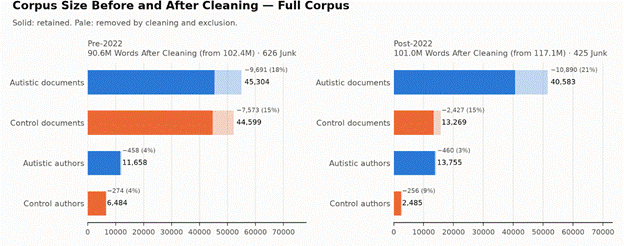
Figure 5 - Data used for this analysis
Post-2022 Controls ended up being much lighter than expected for two reasons:
Post-2022 controls ended up including an enormous number of duplicate posts and reposts which were filtered out in pre-screening (filtered out with exact hash and fuzzy hash >0.8 Jaccard) to prevent double scoring. As years progress, the number of reposts that seep into an ecosystem increases: original posts are reposted and reposted posts are once again reposted. This is especially common in general interest sub-Reddits which have significantly more reposting of older content than other niche sub-Reddits and interest groups (both autistic and control). Both pre- and post-collection filtering aggressively squashed duplicates, which fell disproportionately in post-2022 controls.
The conservative collection screening methods in use were more likely to exclude a potential non-autistic author from a control group than a potential autistic author from a test group.
Finding suitable post-2022 controls that could not plausibly be autistic proved a very difficult challenge. Explicit identification as autistic is far more common than explicit denial, and explicit denial comes with the challenge of undiagnosed autistic people who later start to identify as autistic or use autism-related terms for self-description. Over nine hundred different authors were found to have explicitly denied they were autistic and then, several years later started to use autistic self-identification terms which made control filtering even harder. Additionally, autism as a meme/joke (e.g. “I’m so f*cking autistic” used to express “I feel socially awkward”, not “I have a neurodevelopmental disorder”) made identification of plausibly not autistic authors much more difficult in post-2022 controls. In other research, false positive rates varied by sub-community, age, and demographics. This was verified through direct follow-up (DM, email, video/voice call, and human interaction). From direct follow up, false positives for autism self-identification within younger-age cohorts was between 15-20% of all people depending on the sampled sub-community (with a ~74% non-response rate). This effect means that non-autistic controls will get more heavily filtered in both pre- and post- data processing.
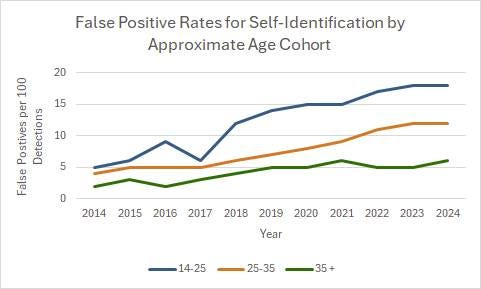
Figure 6 - Number of False Positives for Autistic Self-Identity Claims in Posting Per Year From Other Research
Genre, style, and length matching autistic writing with non-autistic writers after 2022 ended up being a significantly more difficult challenge to overcome than initially thought. Post-2022 controls were still representatively matched with pre-2022 control sources. While the post-2022 controls are imperfect and an area for future work, proportional weighting still gives rough equivalents that allow mapping of post-2022 trends.
False Positive Identification
Because very strict self-identification criteria and conservative scoring was used, FPRs for autistic authors used in the study is likely in the ballpark of 2% but it isn’t possible to verify this without significant further enrichment that attempts to reconstruct user PII and demographic information from their posts and posting history.
It is possible to do additional persona enrichment using a variety of techniques that were beyond the scope of this paper. These techniques involve mining and extracting PII and inferred patterns of life from posting habits. In order to ensure that this data set could be shared with future researchers, PII recovery, analysis, and cross reference and cross application deduplication and identification were not conducted to ensure privacy.
Milieus
A breakdown of data and the sources from which data was collected are below. Blue indicates communities used only to populate the autistic arms, orange indicates that they were only used to populate control arms, and purple indicates hybrid user selection
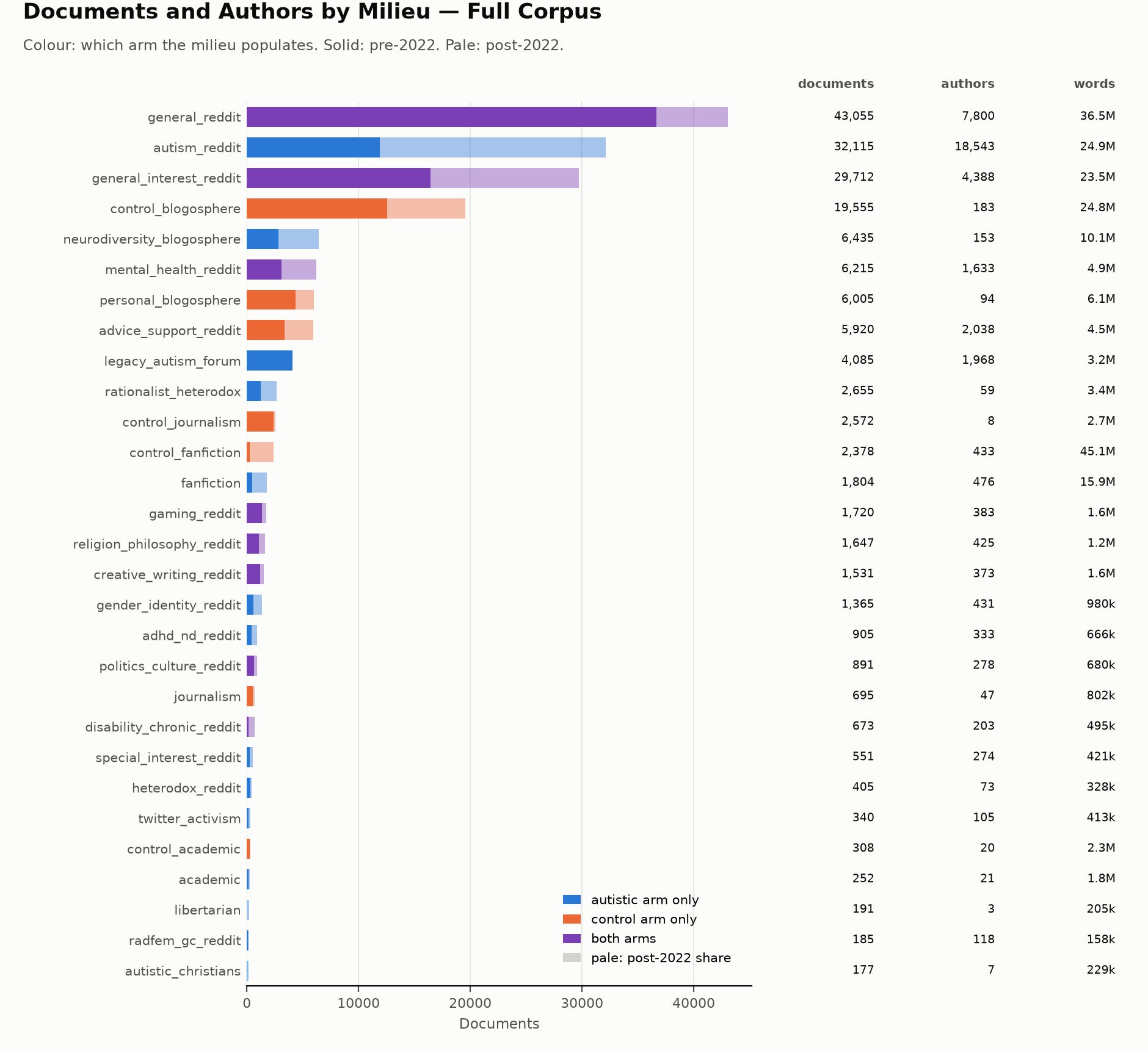
Figure 7 - Breakdown of Sources Collected by Milieu
Detector Performance
Before establishing if AI detectors have bias when analyzing autistic and control writing, it was necessary to establish detector reliability on this data set. Detectors with much higher reliability showing a bias is a significantly more meaningful signal than unreliable detectors showing bias.
Six categories were used to judge detector efficacy:
FPR on full documents
FPR by document segment
Estimated True Positive Rate (ETPR)
Disclosed AI TPR
TPR vs FPR Ratios
Detection rates over time.
FPR on full documents
Detectors were analyzed by their detections of documents in the pre-2022 false positive pool. LLM Judges were only run against the pre-2022 data in the LLM Large and Small data sets. Other detectors were run against the full corpus. The performances of all detectors ordered from least to most effective by proportion of flagged documents is shown below.
Note: LLM data sets are 50% of their normal size because exactly half of the corpus is pre-2022 and half is post-2022.
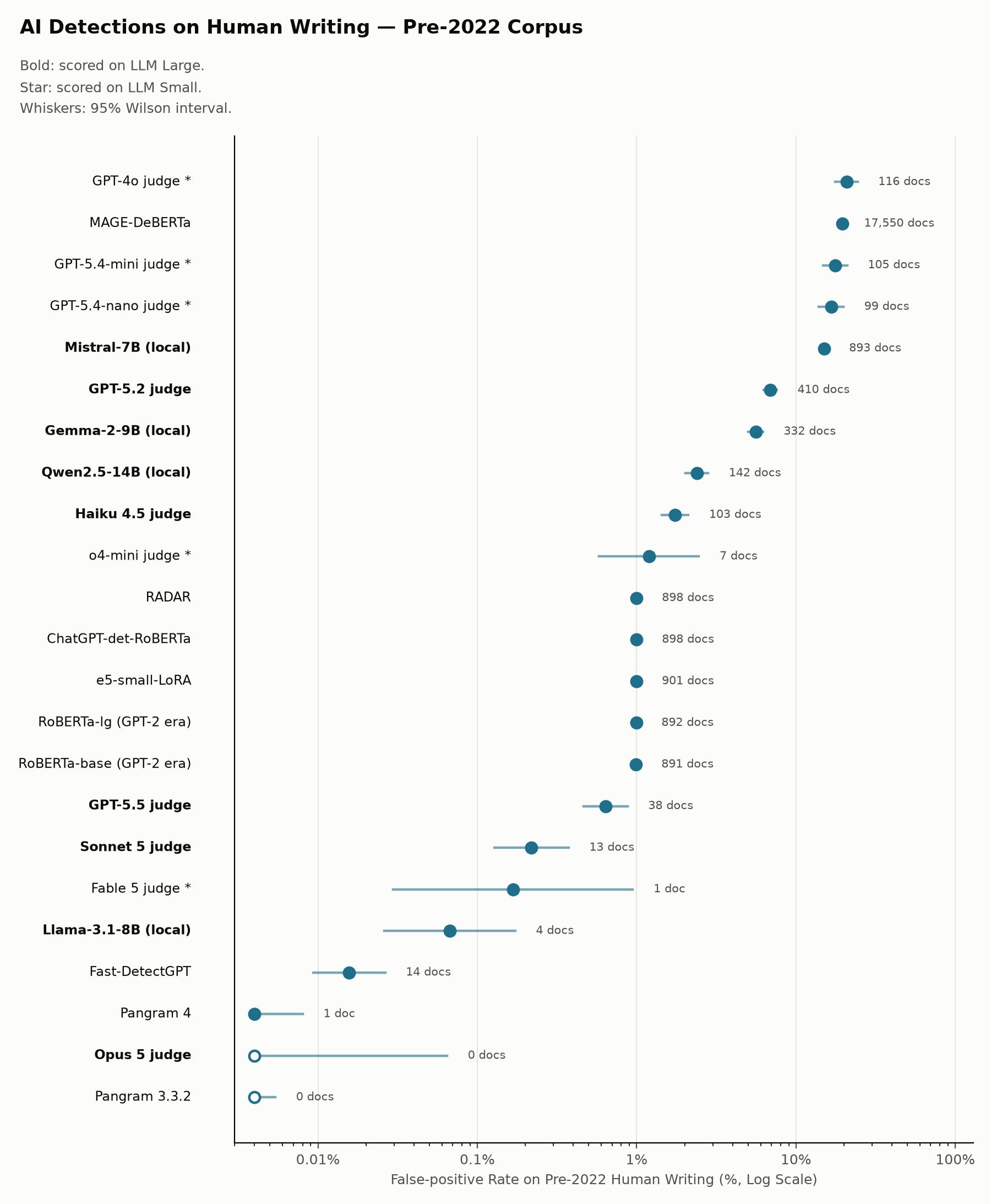
Figure 8 - Pre-2022 Corpus False Positive Rates by Detector (Largest Data Set Available)
False positives from only detectors run on the full data set are shown below:
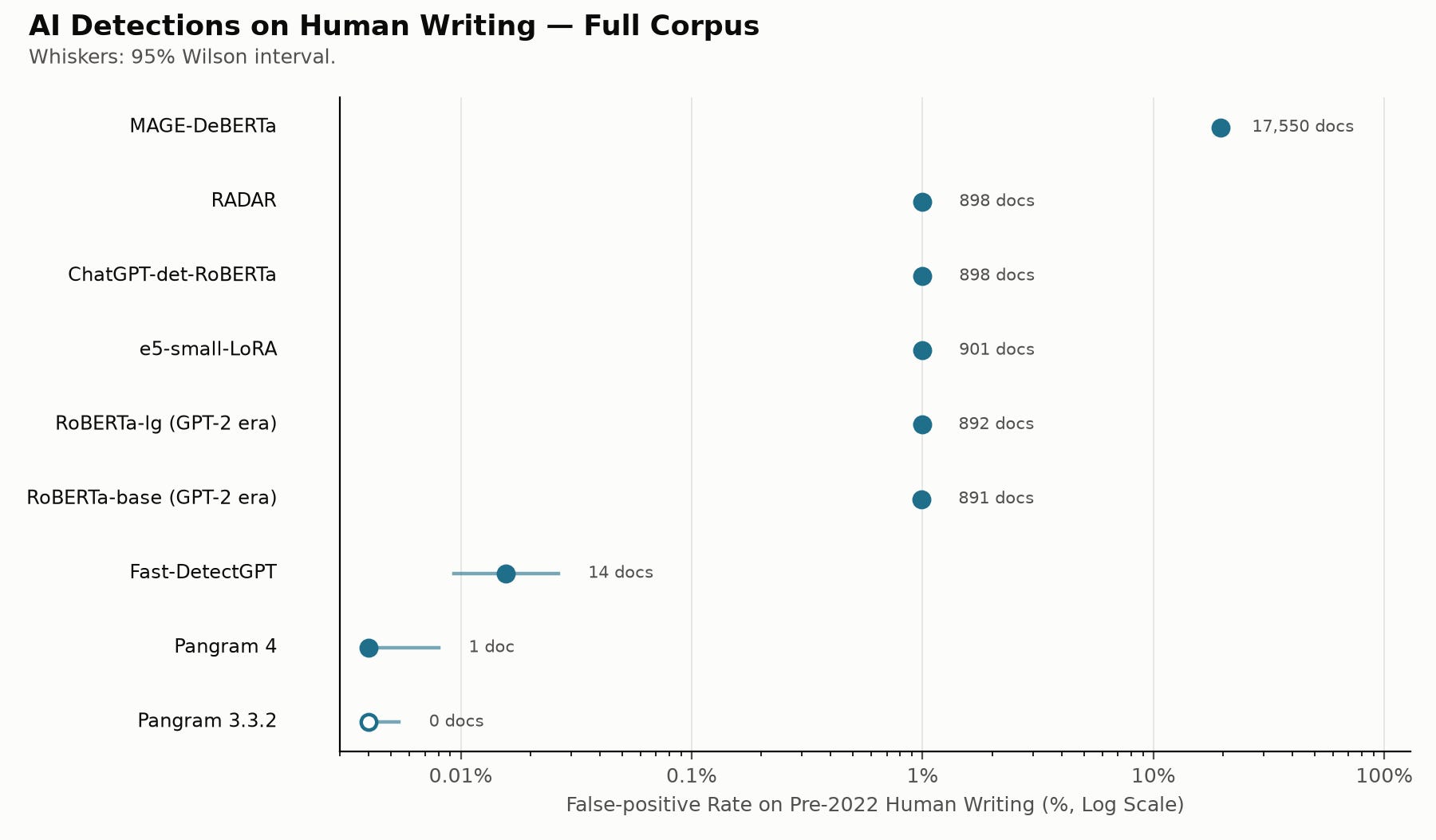
Figure 9 - Pre-2022 False Positive Rates by Detector (Full Corpus Only)
All detectors, run against only documents from the LLM Large data set are below:
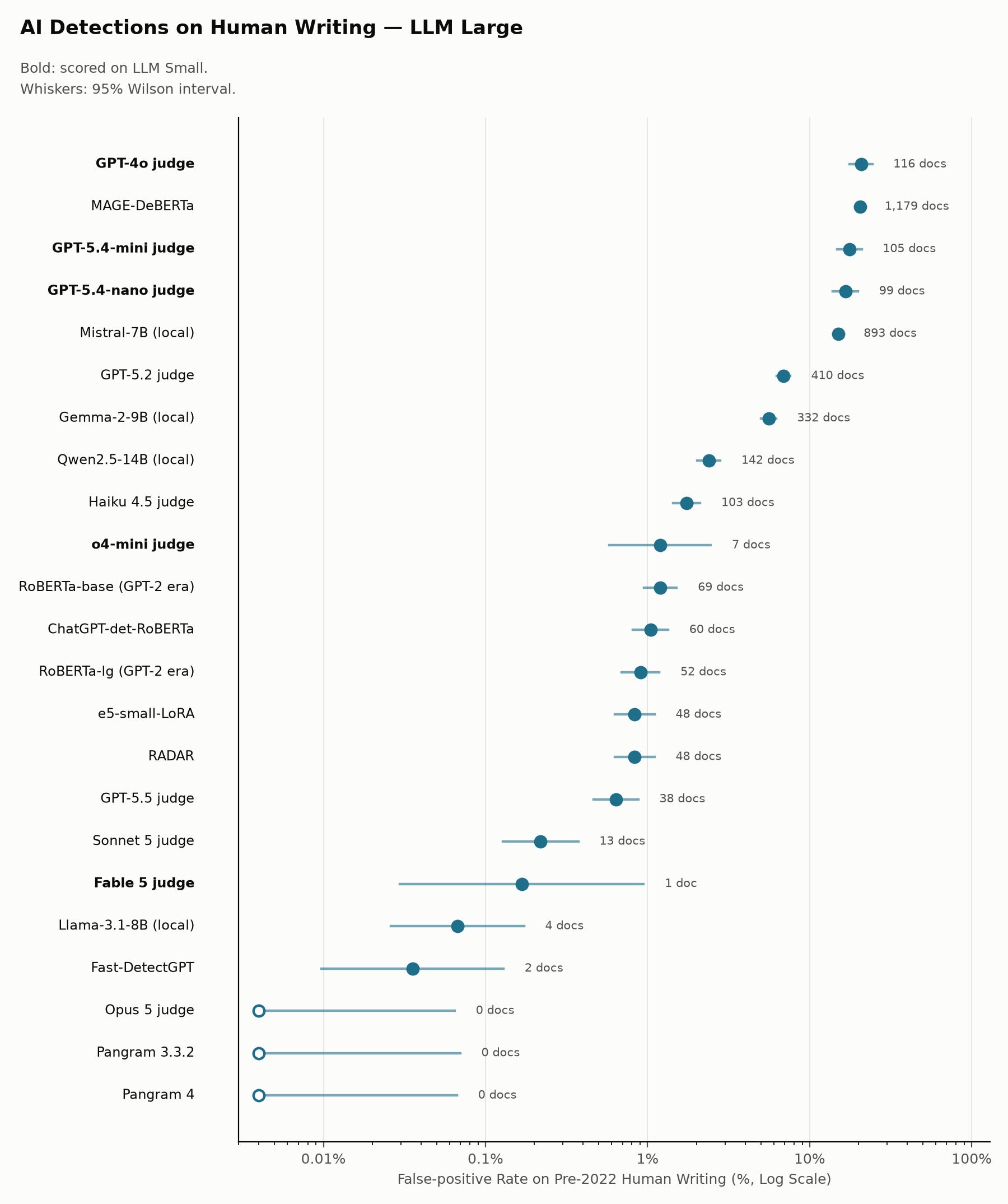
Figure 10 - Pre-2022 False Positive Rates (All Detectors Restricted to LLM Large Only)
FPR by document segment
AI Detectors were also tested on pre-2022 text, both on the full corpus and only LLM Large data sets. Detectors were ranged by proportion of documents with at least one window/segment flagged as AI. Results for the full corpus ranked by proportion of flagged documents is below:
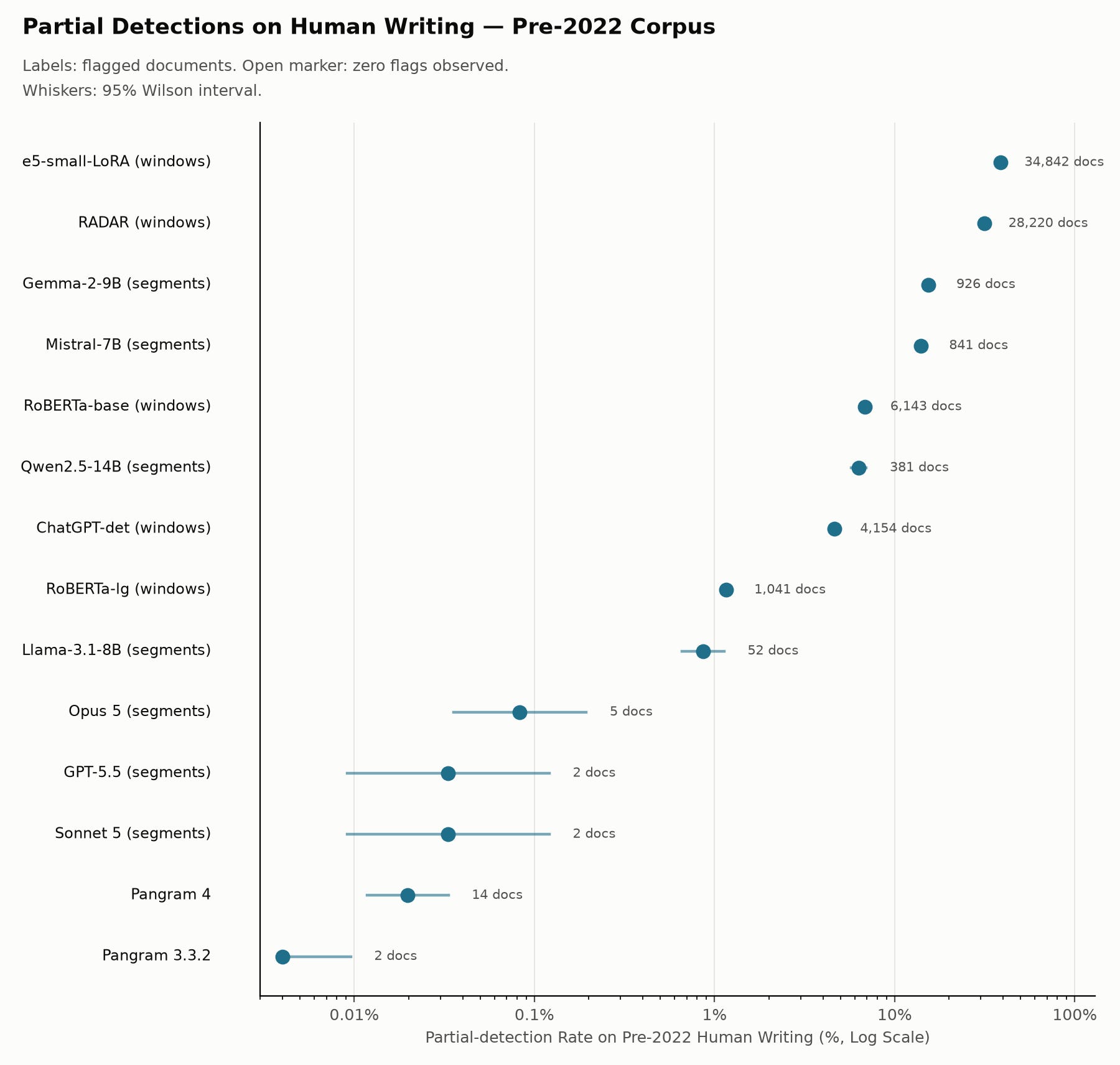
Figure 11 - Detector Performance on pre-2022 False Positive Pool (any flagged window) on all Data Sets
Detections were rebalanced only on the pre-2022 LLM Large data sets. Results were rescored on only documents flagged in the LLM Large data set. Results are below:
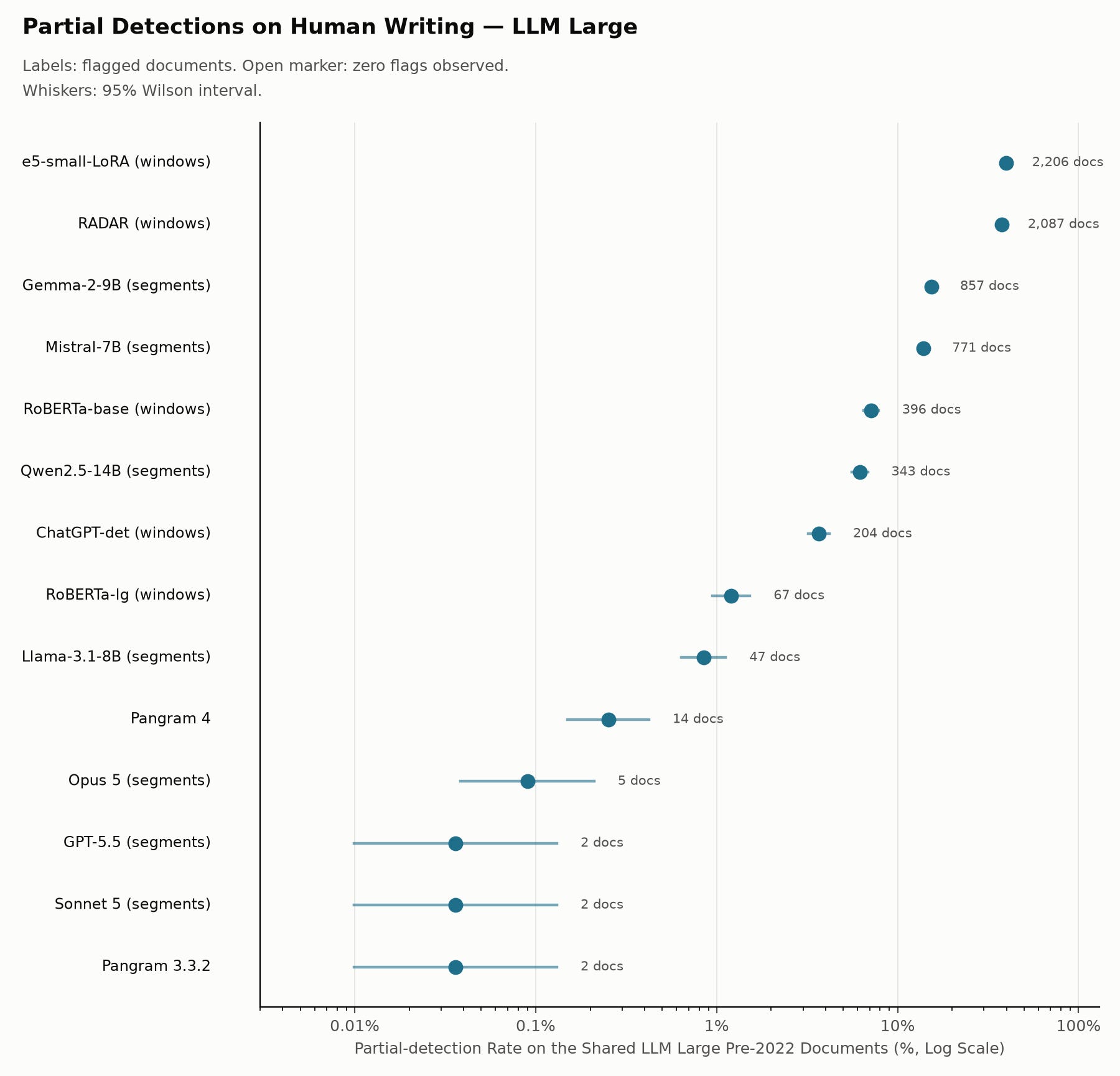
Figure 12 - Detector Performance on pre-2022 False Positive Pool (any flagged window) Restricted to LLM Large
Estimated True Positive Rates (ETPR)
Each detector was evaluated by how many documents in the Estimated True Positive Pool (ETPP) it flagged.
Results for true positive detection performance are below:
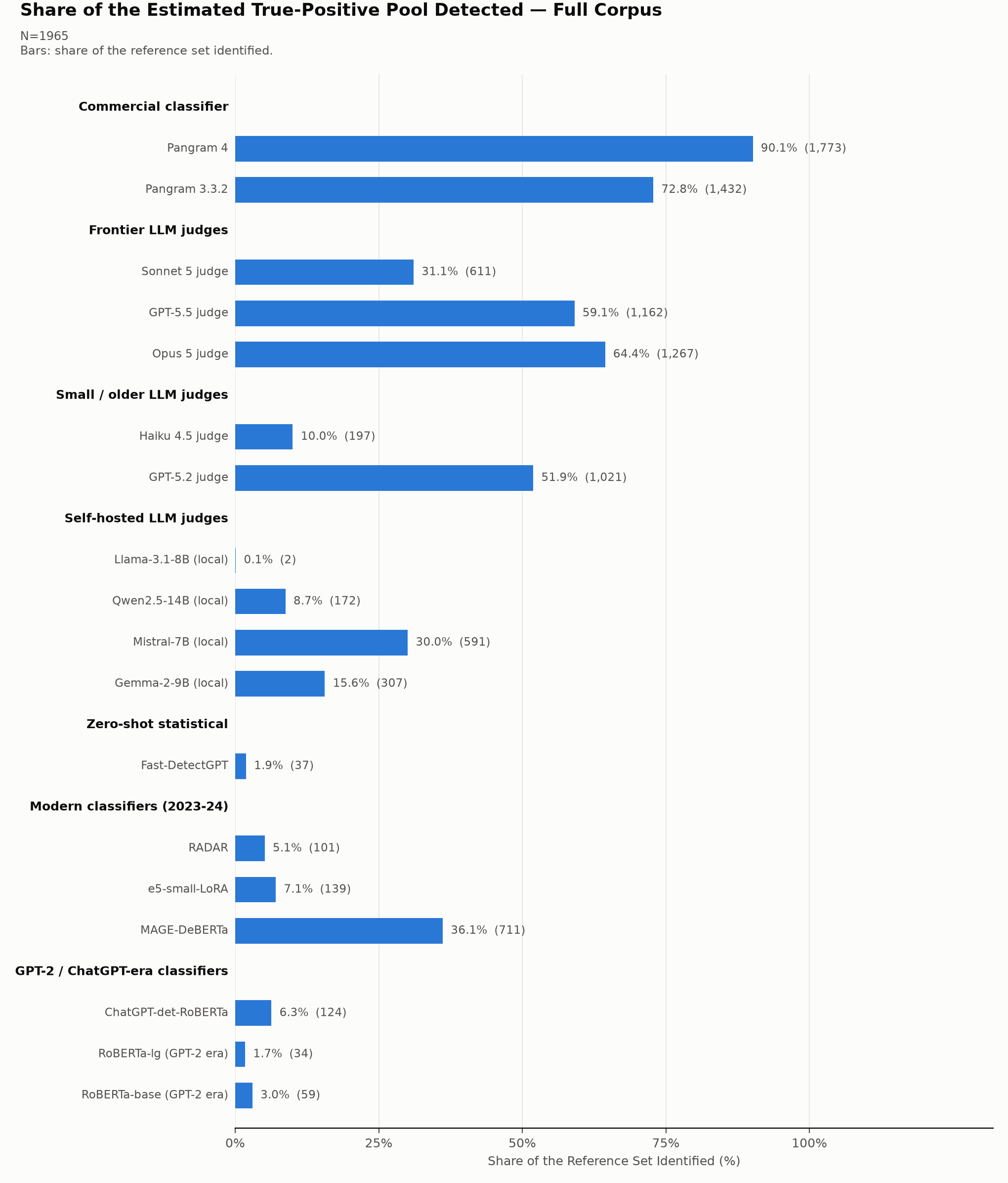
Figure 13 – Detector Ranked Estimated True Positive Pool Detections
Disclosed AI TPR
The pool of documents with disclosed AI either in the document, title, or author bio were also evaluated. These were considered a significantly stronger TPR signal and the closest corpus to known AI usage rather than suspected AI usage. In the whole corpus 392 texts had disclosed AI usage.
Analysis of the corpus found 20 documents with disclosed AI text from the pre-2022 corpus. All of these documents are artifacts from early AI adoption on the internet, including a 2021 lesswrong post of a user interviewing a GPT-3 simulated Yudkowsky, and several GPT-2 Jordan Peterson impersonation posts in /r/enoughpetersonspam. The rest of the documents with disclosed AI text were from the post-2022 corpus.
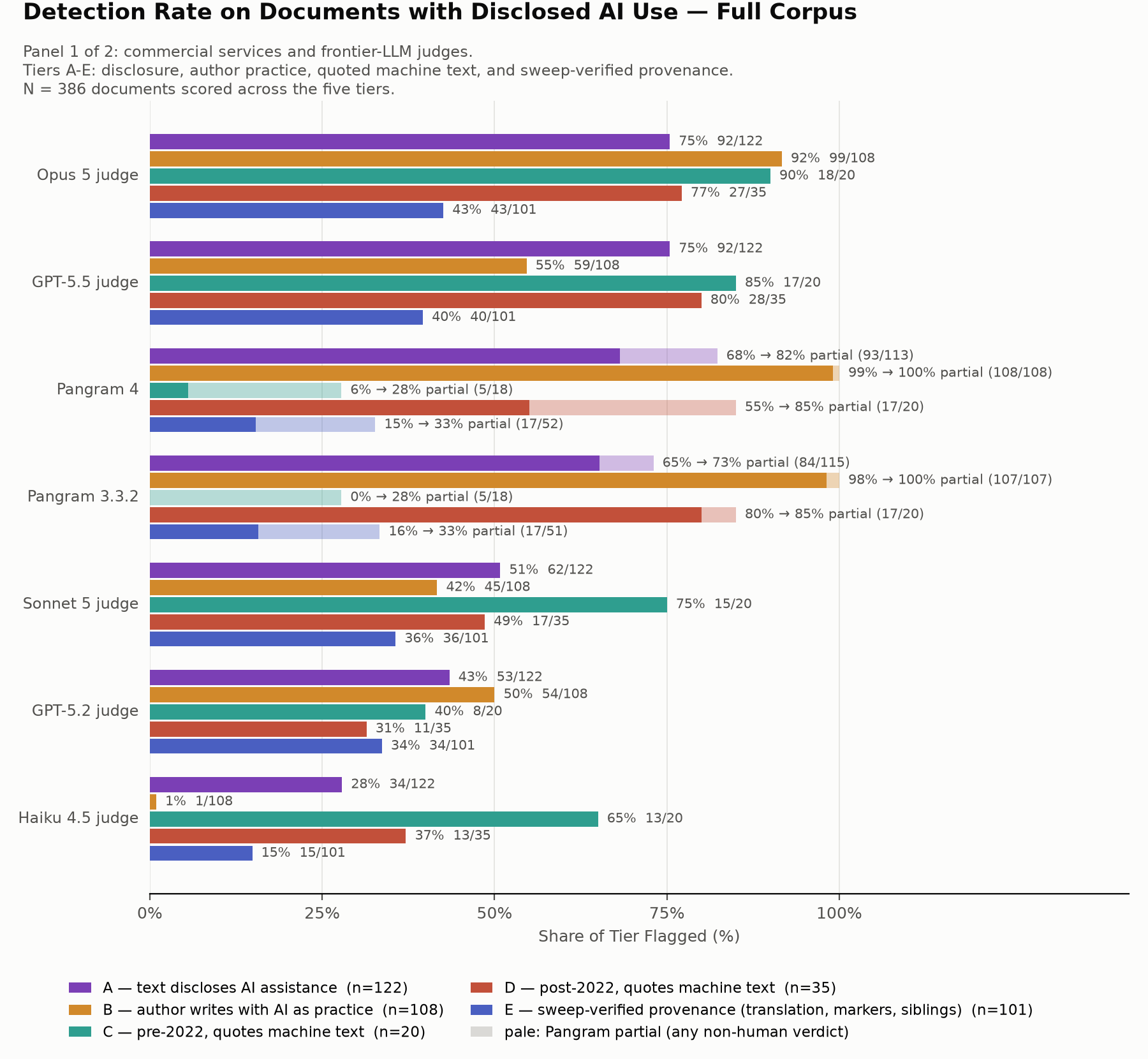
Figure 14 - Detectors on Self-Disclosed AI Text (Commercial Services and LLM Judges)
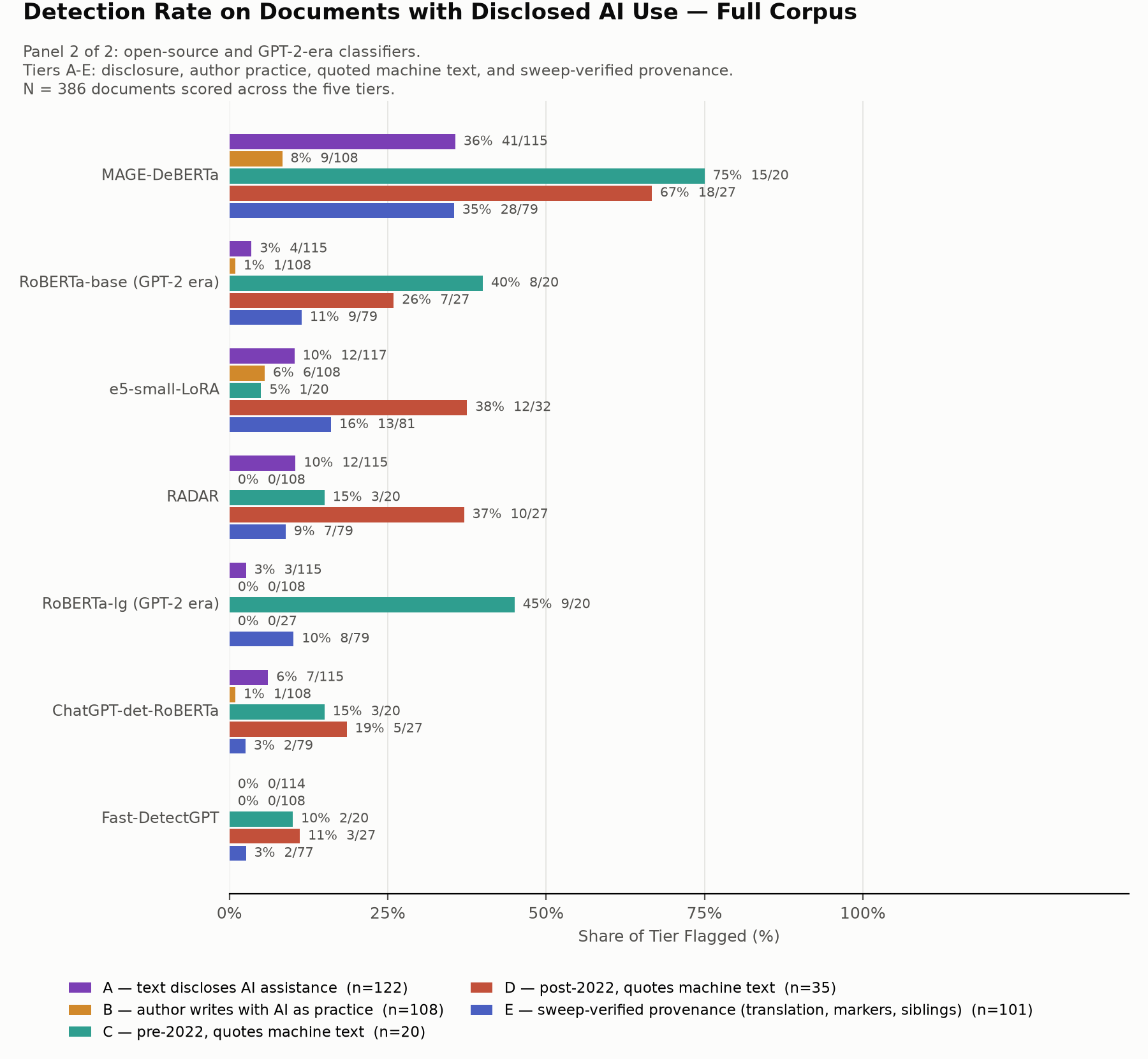
Figure 15 - Detectors on Self-Disclosed AI Text (Open-Source and GPT-2-Era Classifiers)
TPR vs FPR Ratios
Rates against the full corpus would likely be in a similar range. Detector performances on True-Positive vs False-Positive ratios were also judged.
Below is an analysis of AI Detector Estimated True Positive vs False-Positive Rates using ETPR and FPR from the largest data set on which every detector was run.
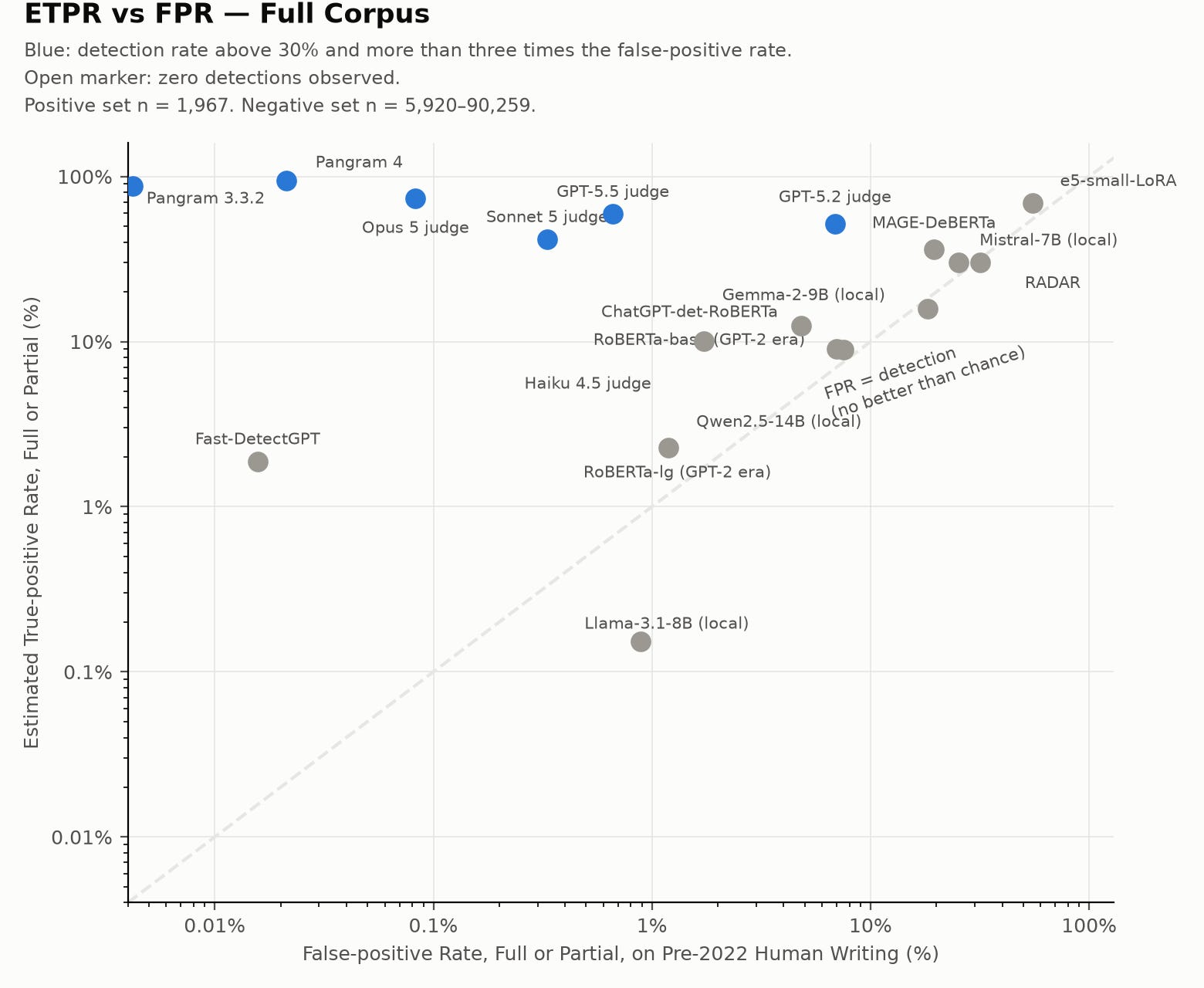
Figure 16 - ETPR vs FPR ratios for all detectors
The graph below shows the same rates, differentiating full-document false positives from segment or window false positives.
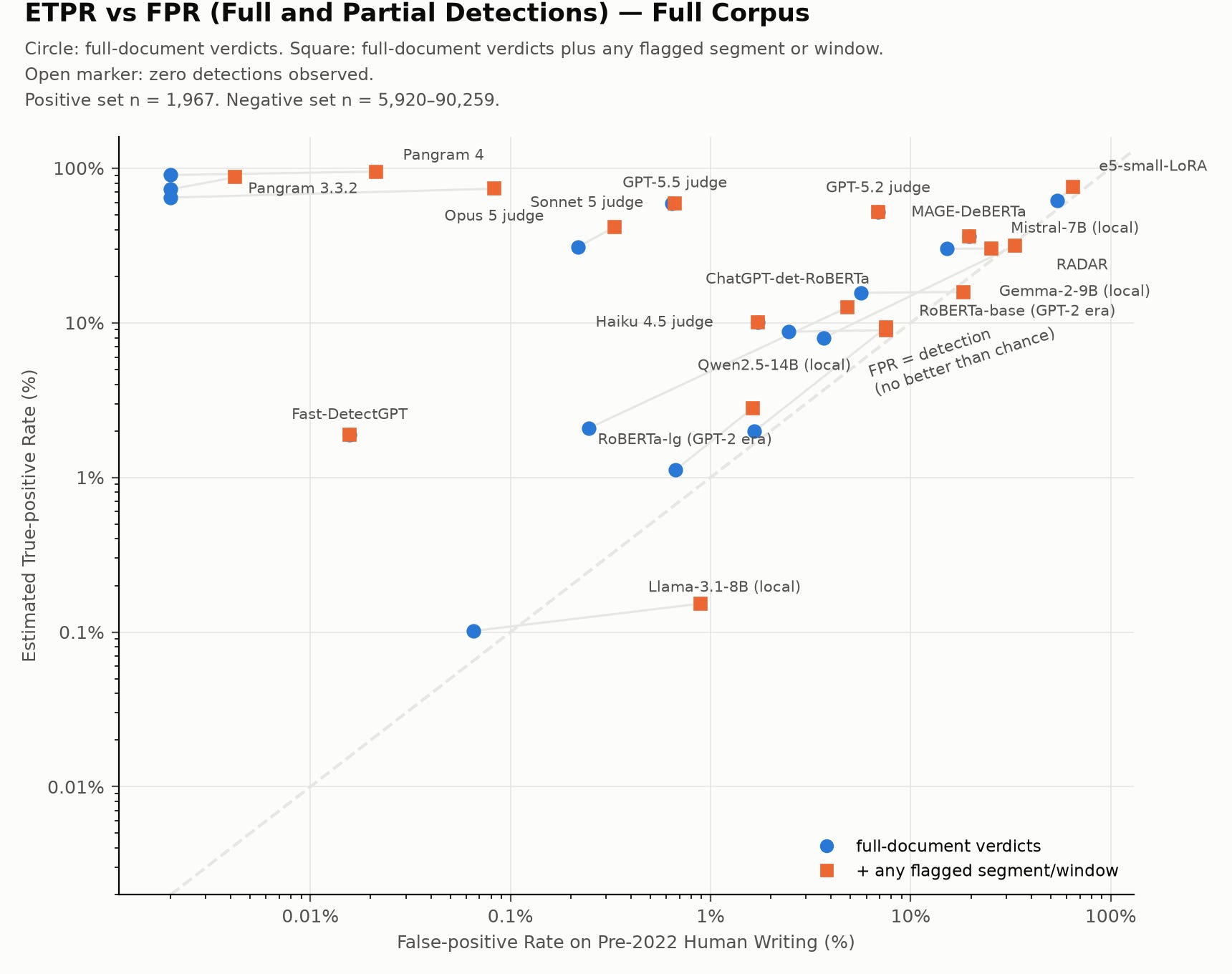
Figure 17 - ETPR vs FPRs (including Partial Detections)
Detectors were then compared by their performance on only true positives as determined by in-document disclosure, which is the closest to the true positive ground truth that can be determined for this study.
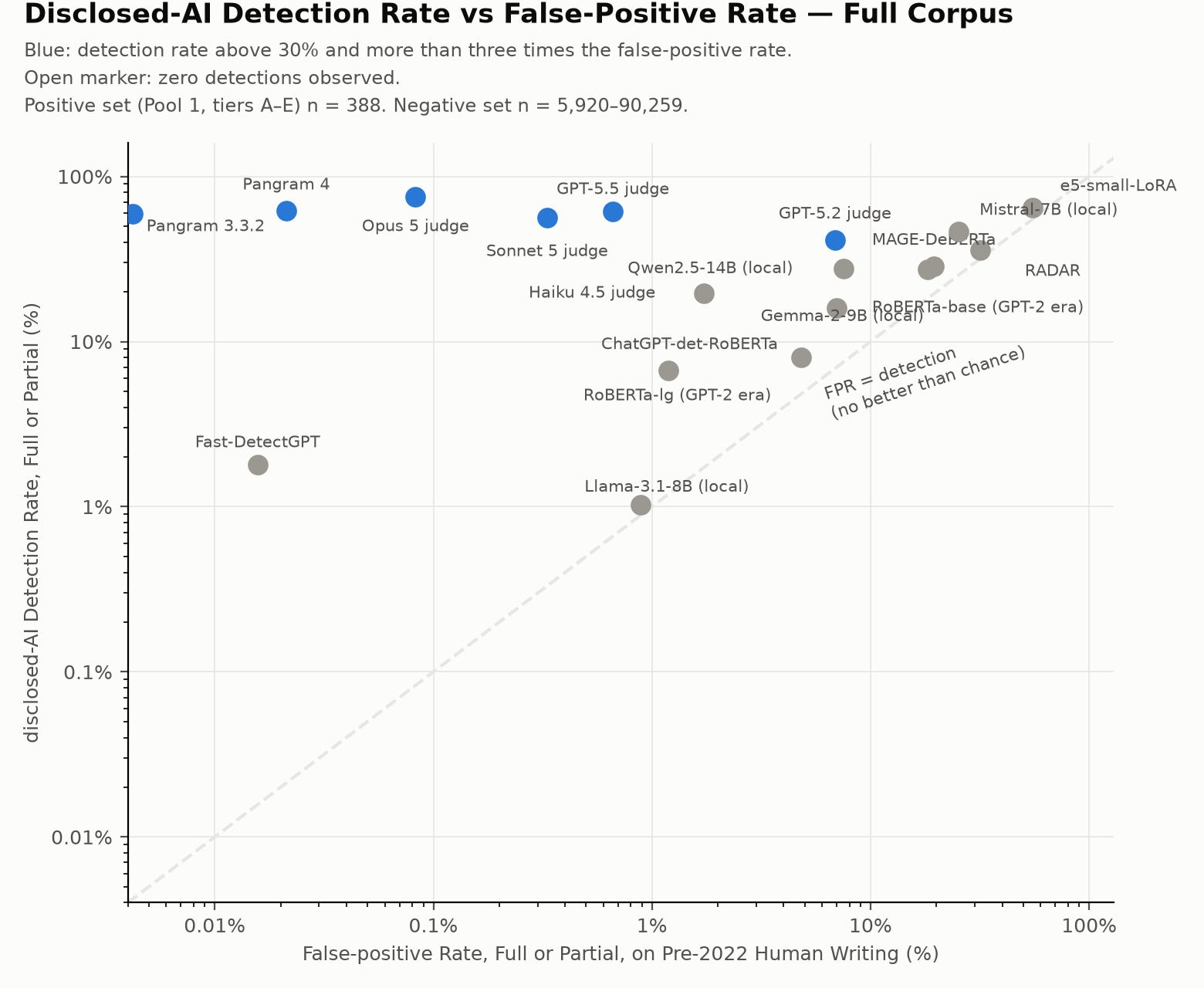
Figure 18 – TPR vs FPR on Known Documents with AI Disclosure
Both rates of ETPR and detections on documents with known AI disclosure are combined here:
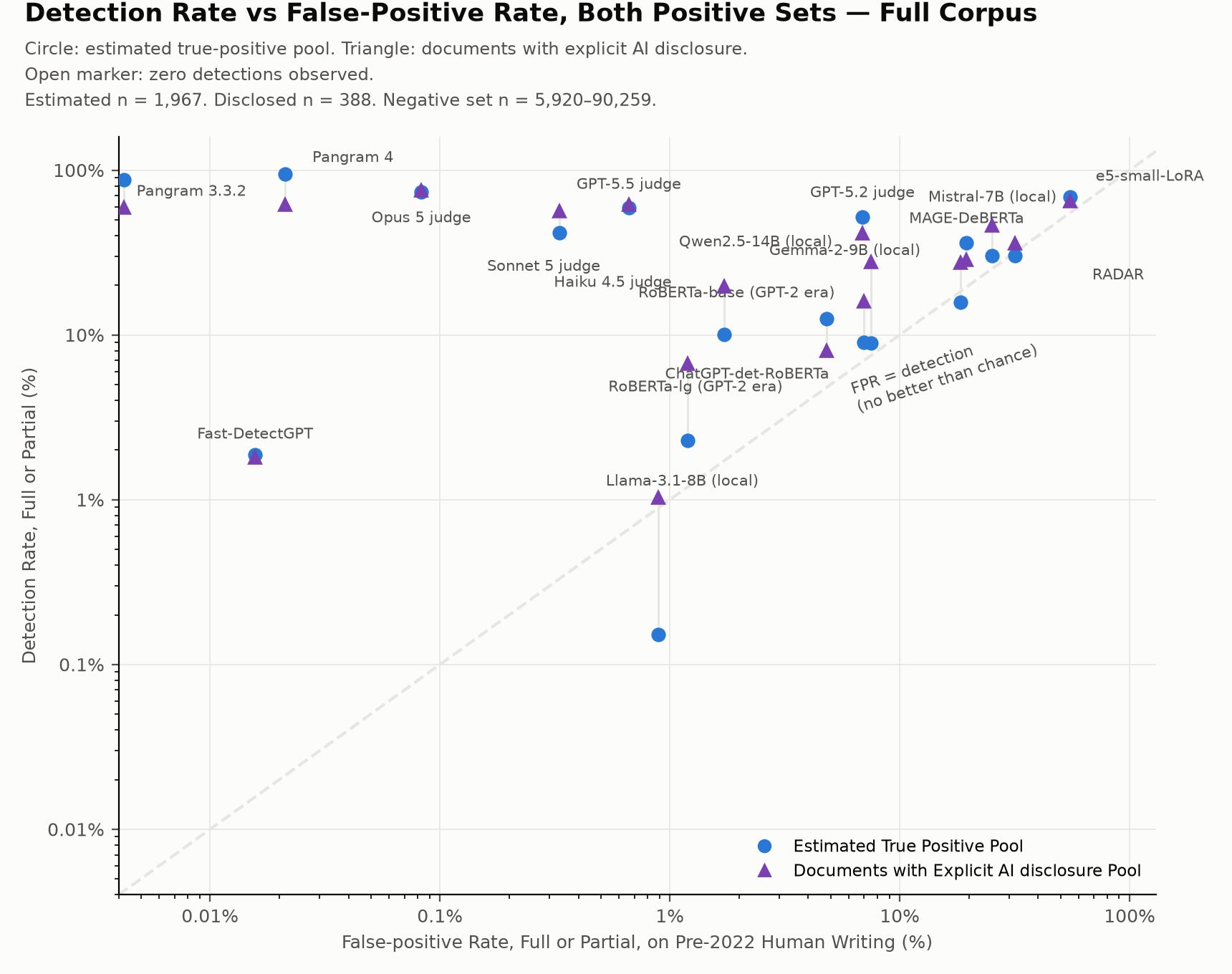
The detectors were finally then ranked on full document AI detections on only the LLM Large data set.
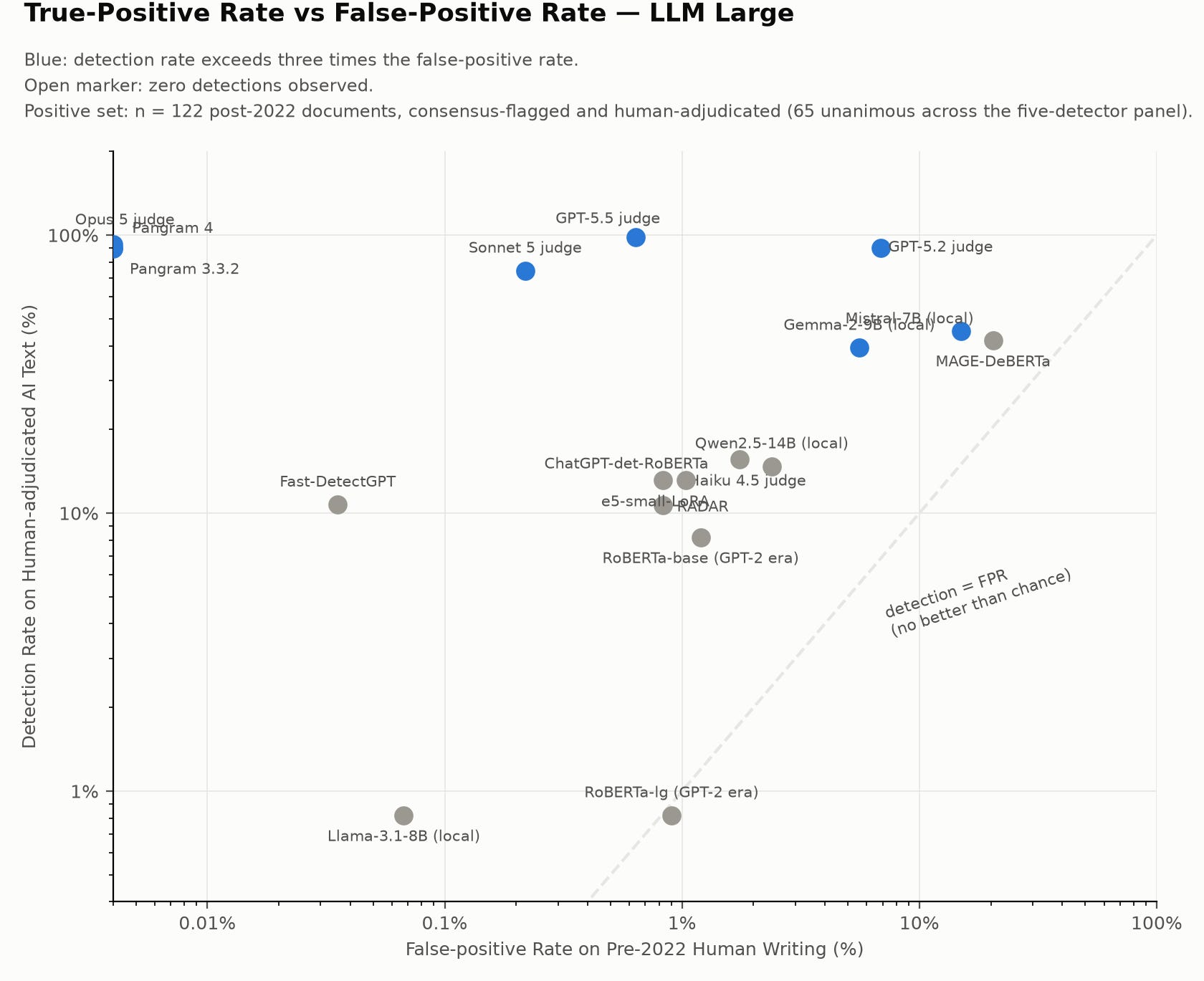
Figure 19 - ETPR vs FPR (LLM Large restricted)
Detection Rates Over Time
Another less distinctive but much easier way to visualize detector reliability is to look at how detection rates change for documents from different years. Looking at the detection curve can quickly show you which detectors have the generally expected results, as detections over time should follow a specific trajectory. This is because AI was adopted over time, slowly at first starting in 2019 with GPT-2 release and then becoming more and more prevalent, exploding after 2023.
For a well calibrated detector the pre-2022 curve should be flat with a very small bump just before 2022 to account for identified true positives from the GPT 2 and 3 era. When the post-2022 AI era hits there should be a slightly larger initial bump that rapidly starts to increase over time. The resulting graph will look like a hockey stick that starts to steeply ramp up post-2022.
A combined collection of detection graphs using both the LLM Large Data Set and Full Corpus, organized from best to worst performance can be seen in the figure below. Note that LLM as Judge and full corpus detectors have different curves because of different data sets with different amounts of data.
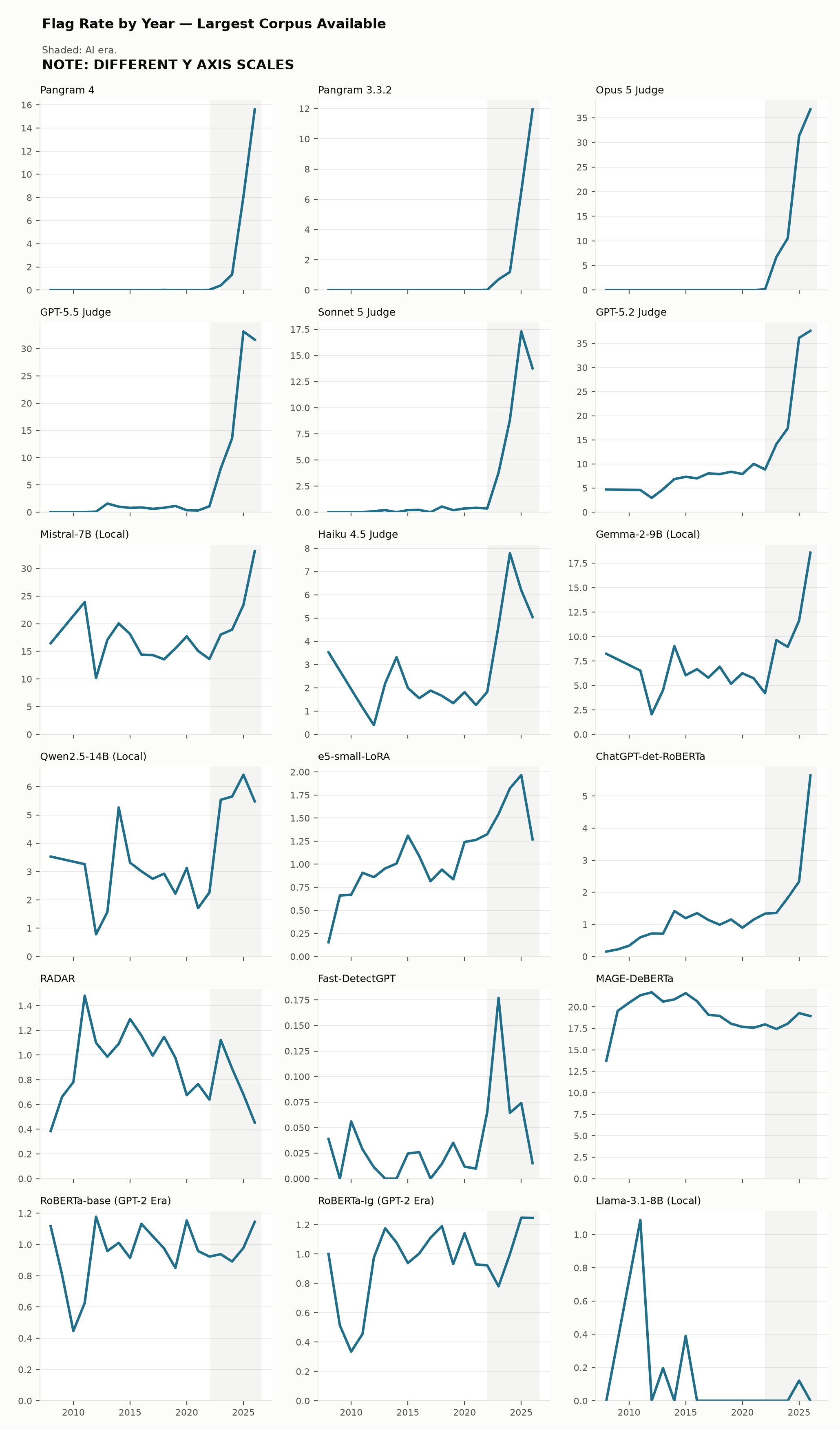
Figure 20 - Combined Detector Performance Curves
Analyzers that all looked at the full corpus are shown below:
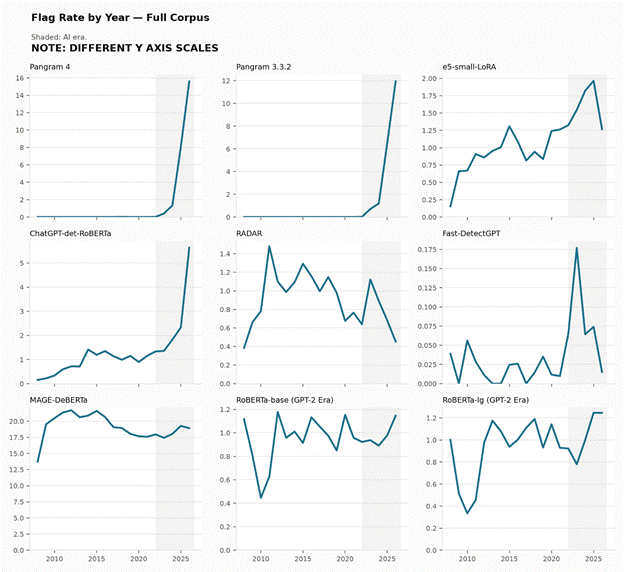
Figure 21 - Detector Performance for detectors run against full data set
Detectors used on the full corpus were then restricted to only the LLM large data set and their detection curves were mapped to enable curve shape comparisons. This was done to enable like to like curve comparisons across detectors run on both the full and LLM Large data sets.
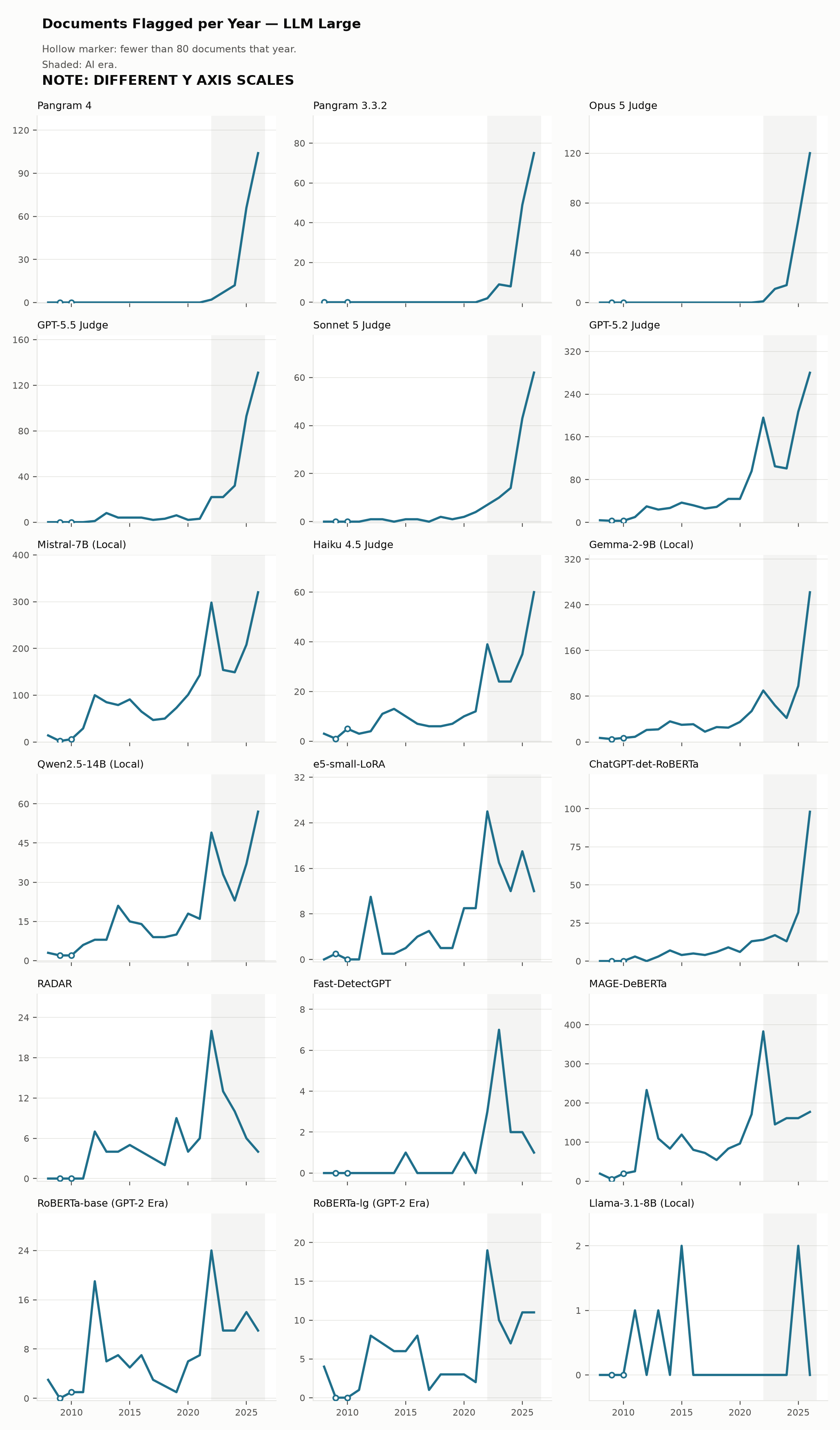
Figure 22 - All Detector Performances on LLM Large Data Set
Detector Performance Summary
Under the four evaluation criteria the top five most reliable detectors in order from most reliable to least were Pangram 4, Pangram 3.3.2, Opus 5, GPT-5.5 and Sonnet 5. Detection curve shape for Pangram 4, Pangram 3.3.2 and Opus were essentially the same with different levels of sensitivity. The main difference between Pangram 4 and 3.3.2 was Pangram 4 was more likely to flag documents in the true positive pool. With respect to false positives pre-2022 they were nearly identical.
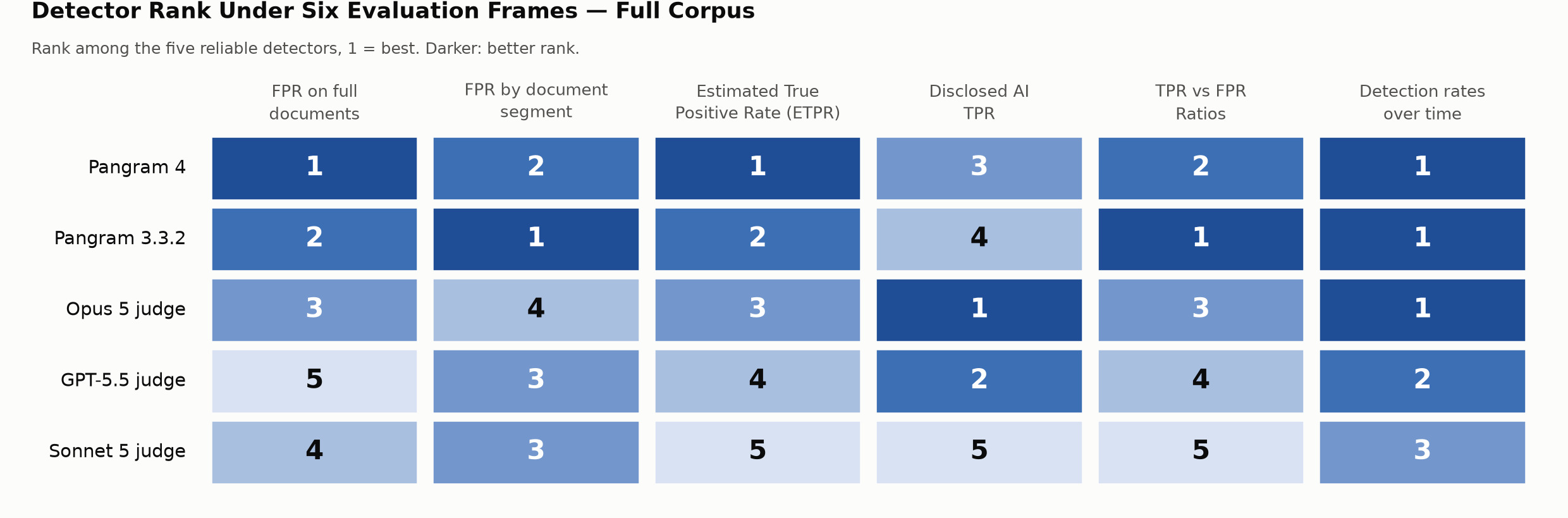
Figure 23 - Overall Detector Performance Summary
Detector Bias
Once detector reliability was established, analysis could be conducted on FPRs on pre-2022 autistic and control arms.
If AI detection software has an appreciable bias against autistic writing, it should show up in the pre-2022 era by flagging documents in the autistic arms at statistically significant higher rates than documents in the control arm. This era has very little actual AI writing in it and are almost all human written so that the vast majority of detections will be on human only writing. Importantly, control arms and autistic arms in this era are roughly matched in count, genre, and corpus composition. This is the cleanest set of like-to-like comparisons where an appreciable bias against autistic people should surface.
Post-2022 data cannot be accurately used to establish bias against autistic people because the chance that autistic people legitimately use AI at a higher rate is a real possibility. Below is a breakdown of disclosed AI usage in documents and by author. Although the post-2022 autistic and control data sets are different, comparisons can still be made between them. Analysis showed that a higher percentage of authors disclosed AI usage in the control arm, but a higher percentage of autistic documents contained AI Disclosure. Many autistic authors in activist spaces explicitly state that they use AI as a disability accommodation tool to facilitate their writing.
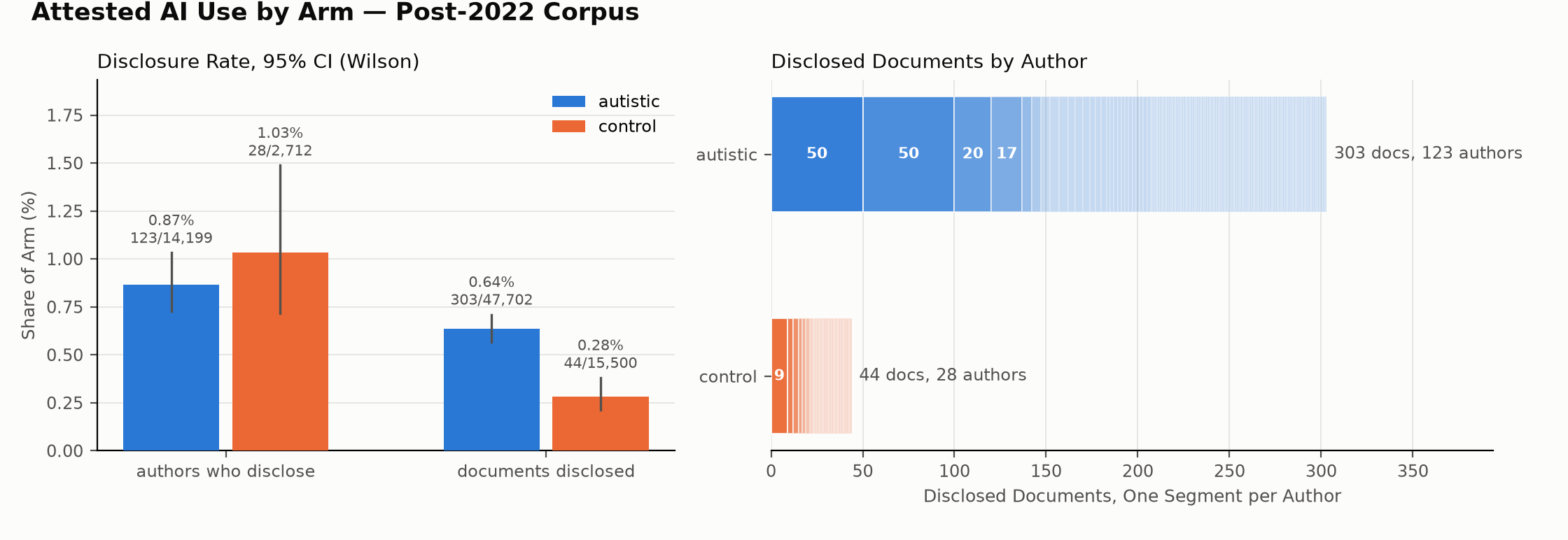
Figure 24 - Autistic and Control AI Self-Disclosure
Undisclosed AI usage in post-2022 data is very hard to gauge with the data set available. In order to establish bias, you would need to have writing that was confirmed to have been written by humans. Writing after the public release of ChatGPT has a very high risk of undisclosed AI contamination so you cannot use this as known human, even if authors explicitly deny AI usage.
Because of these limitations, bias will only be established by analyzing pre-2022 data.
Pre-2022 Full Document False Positive Decomposition by Autistic and Control Arms
The same FPR’s established per detector to establish reliability were re-classified by breaking down their pools into autistic and control FPR. Known true positives were removed from this data set.
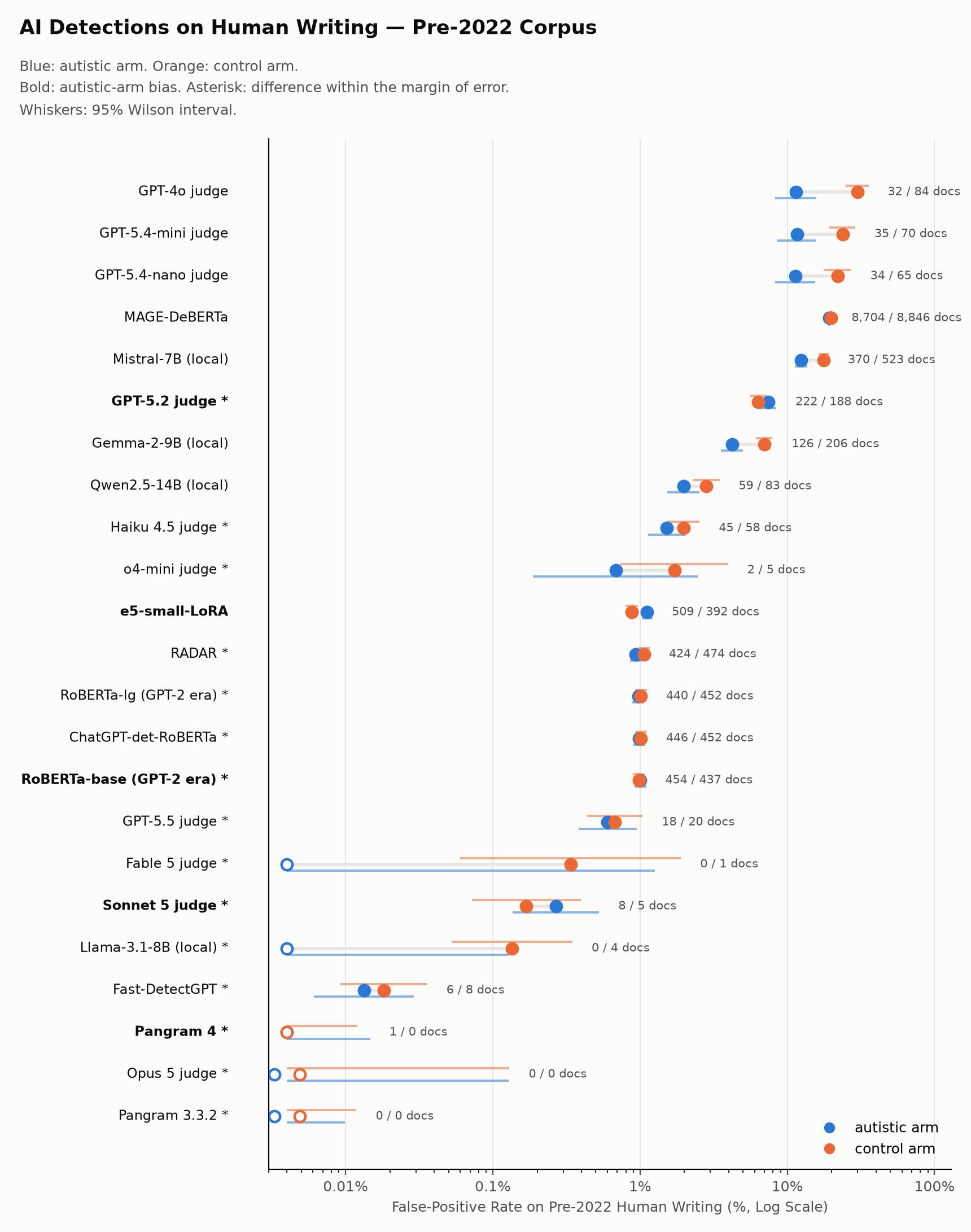
Figure 25 - Unweighted FPRs on Pre-2022 Autistic and Control Writing
Detectors that were run on sufficient sample sizes (over 12k documents) were composition-weighted with very minimal effect. The composition bias results are shown below:
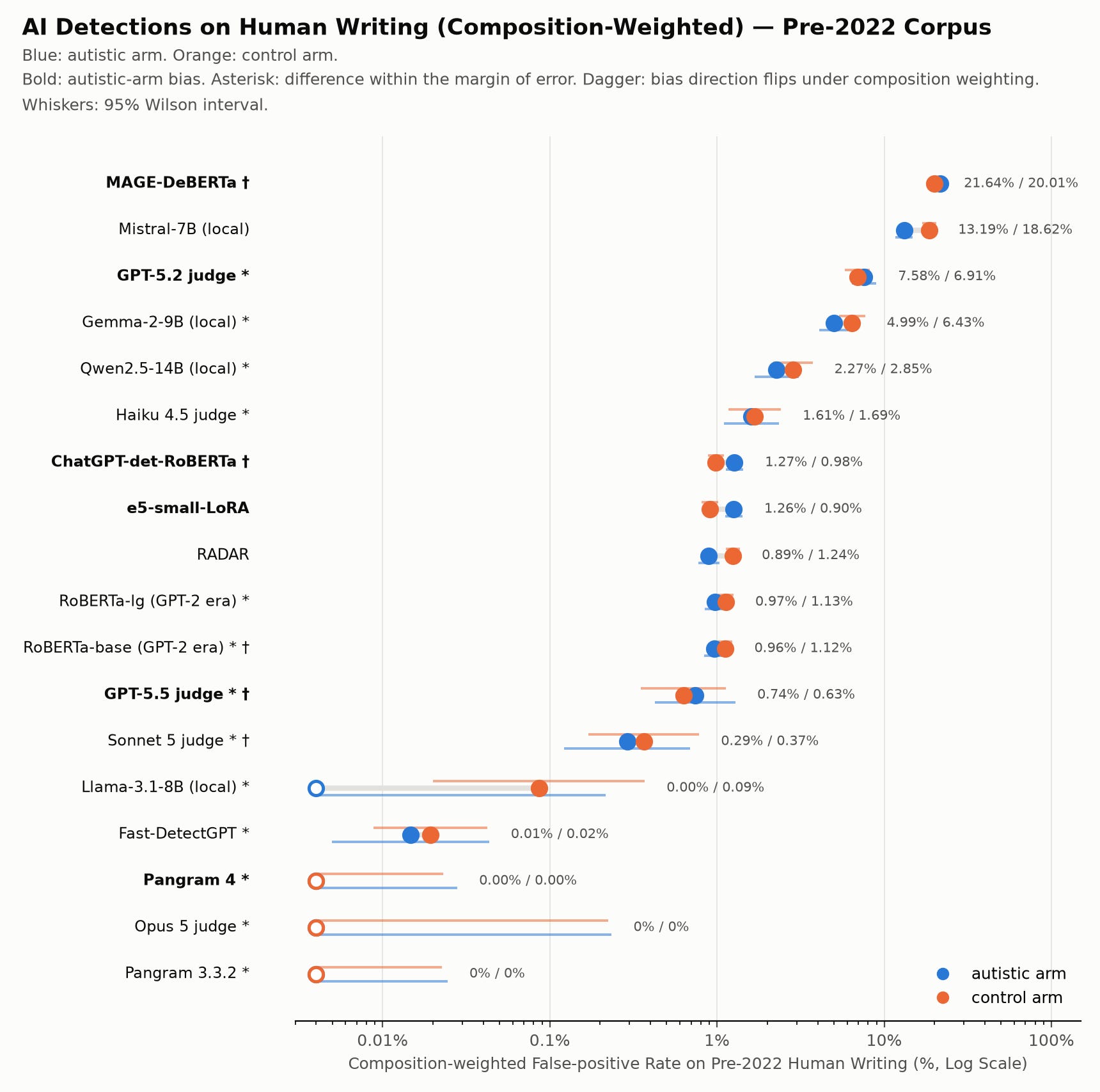
Figure 26 - Weighted FPRs on Pre-2022 Autistic and Control Writing
FPRs per detector on both autistic and control arms were mapped over time as shown in the figure below:
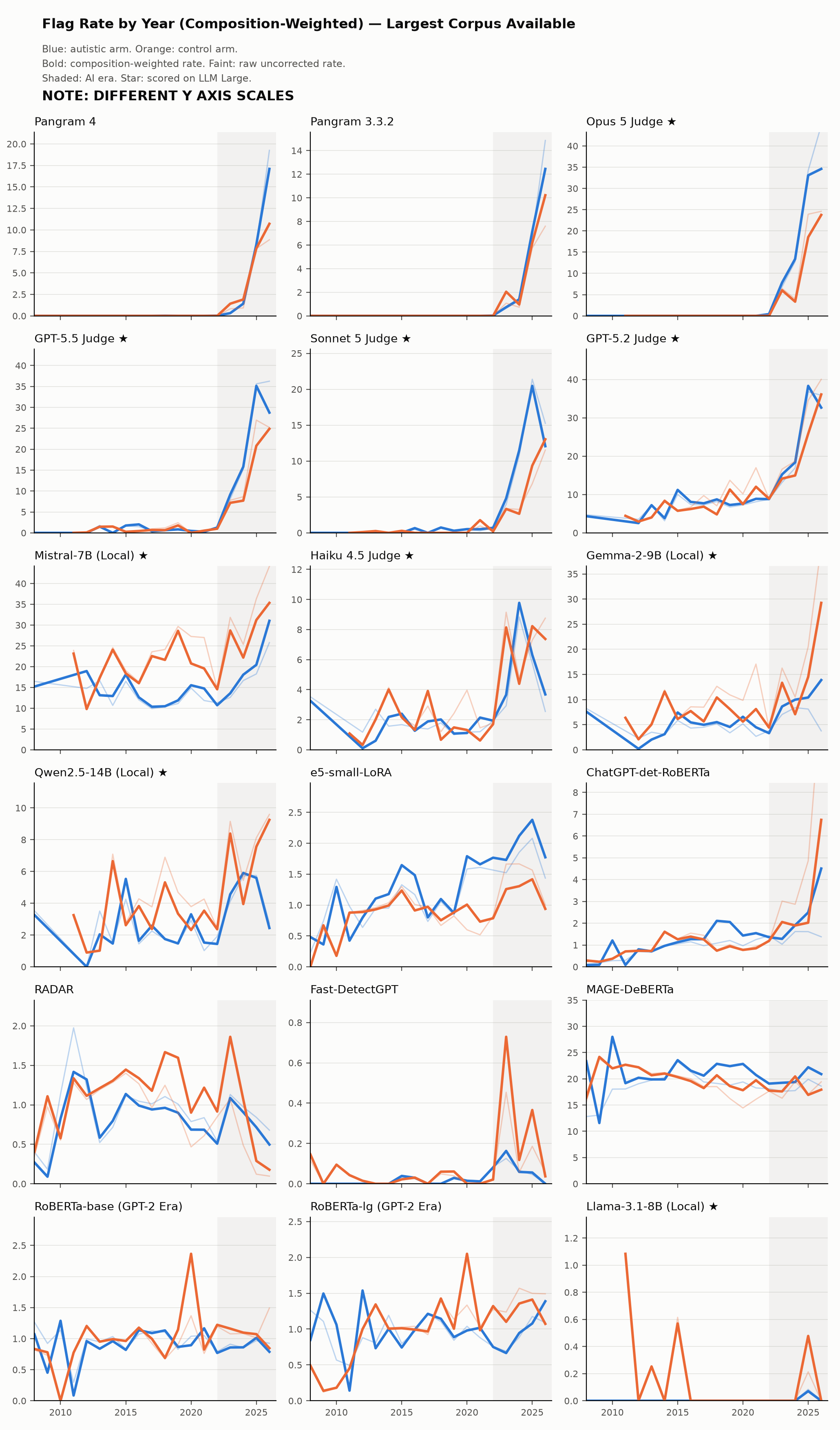
Figure 27 - Documents Flagged Per Year by Autistic and Control Pools (Largest Corpus Available)
The same data, but restricted on only detectors run against the full corpus is below:
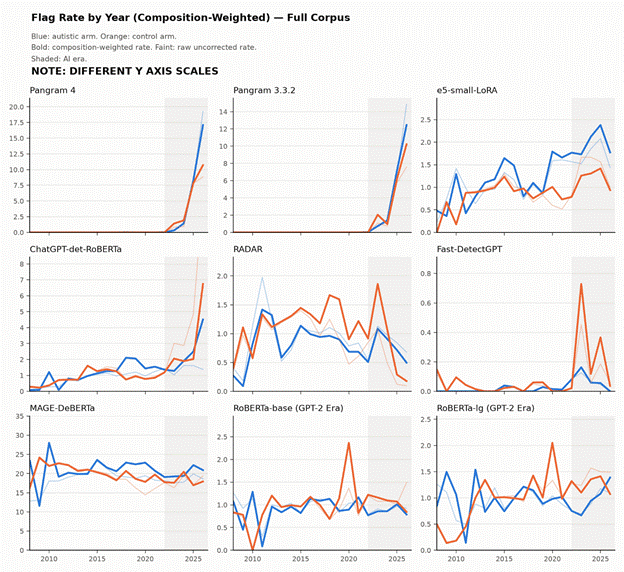
Figure 28 - Documents Flagged Per Year by Autistic and Control Pools (Full Corpus Only)
Finally, all detectors detection curves over time were judged on the restricted LLM Large data set.
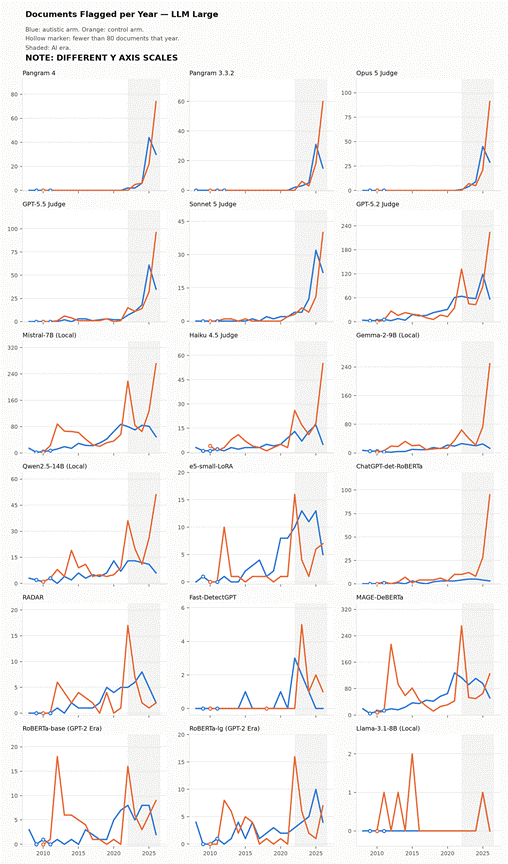
Figure 29 - Documents Flagged Per Year by Autistic and Control Pools (Restricted to only LLM Large)
Pre-2022 Partial Document False Positive Decomposition by Autistic and Control Arms
Documents that were analyzed in segments were also weighed by bias to determine if AI detectors had a bias at the window/segment layer. Results are shown below:
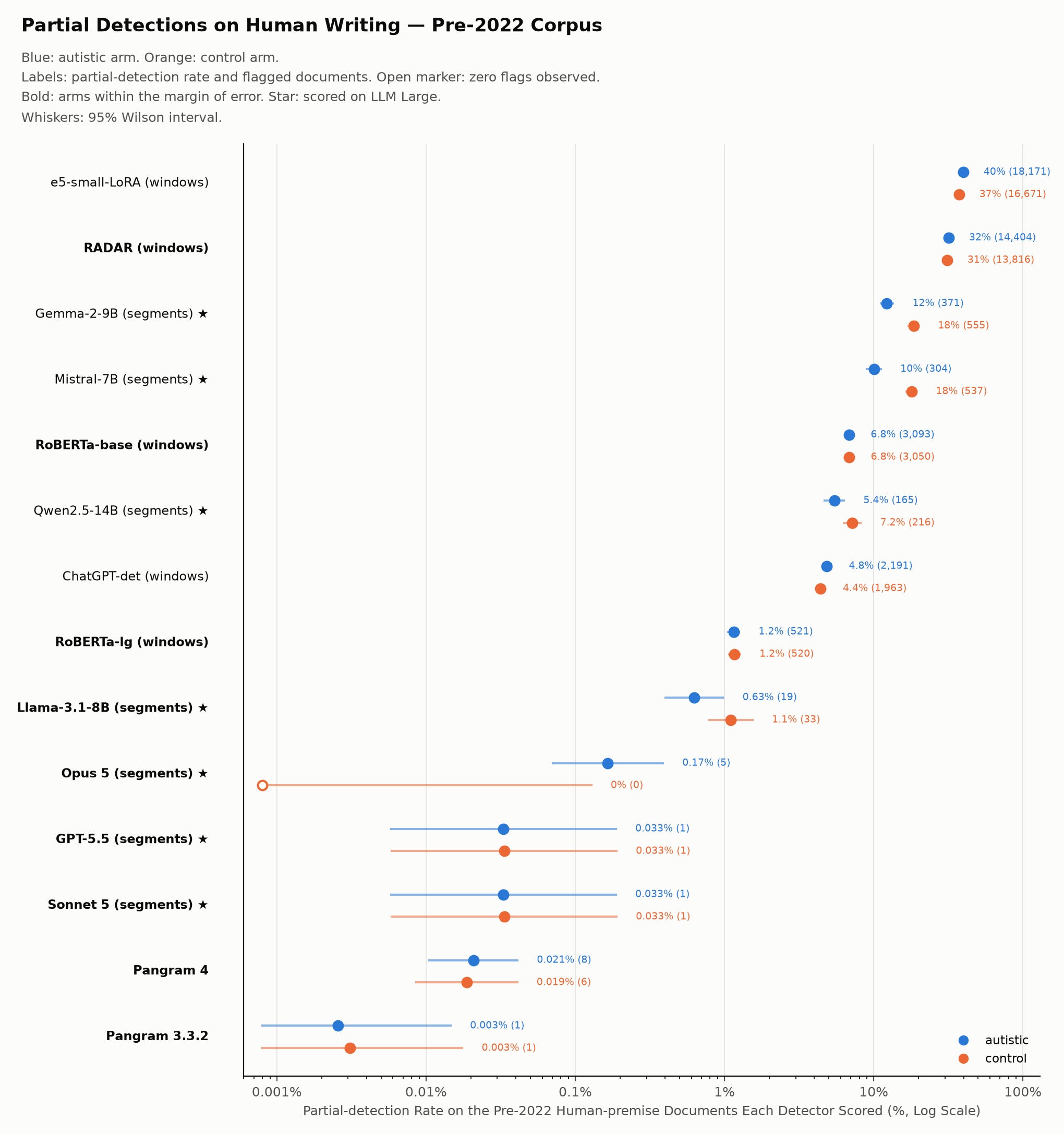
Figure 30 - Number of Documents with False Positive Partial AI Detection (Largest Corpus Available)
Finally, documents with more than one segment flagged as AI were mapped against pre-2022 autistic and control arms to see if it was more likely for a document written by an autistic author to have a partial AI flag. This breakdown is below.
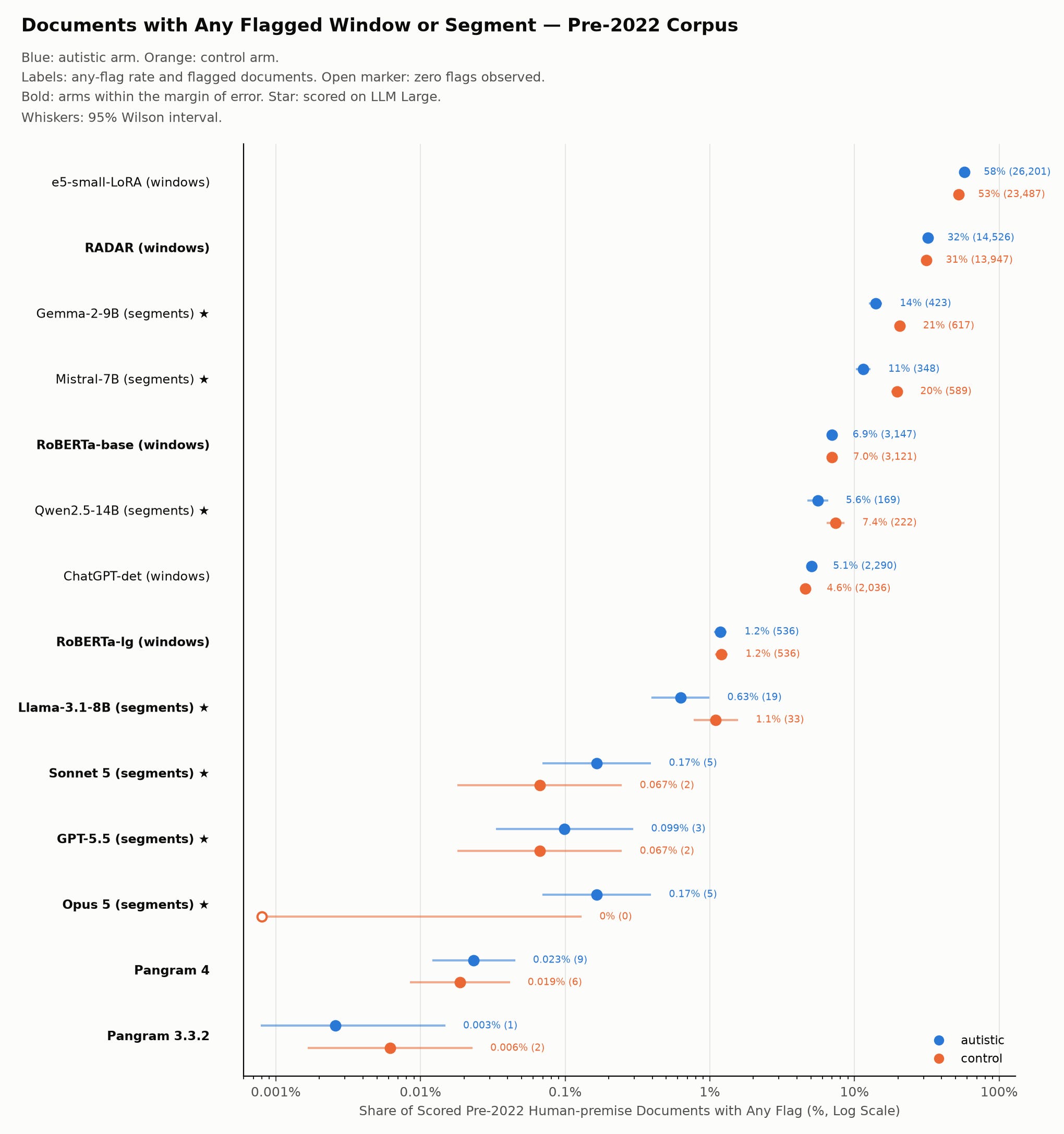
Figure 31 - Number of False Positive AI Detections on any Window or Segment (Largest Corpus Available)
Pre-2022 Mid-Range AI Confidence Scores
In analyzing false positives due to AI detection, it is important to also consider moderate confidence detections. A student getting 75% confidence AI detection is almost as likely to trigger false positive complaints and academic misconduct review as a 100% confidence detection. Analysis was conducted to determine if a bias existed against autistic writers at lower-than-certain confidence intervals. Cumulative counts for any documents rated as AI between 20-80% confidence are shown in the figure below, and demonstrate a lack of bias against autistic writing at lower confidence thresholds.
Note: Pangram only provided three confidence buckets and did not provide a fine grain confidence score so it cannot be easily scored against the other detectors which gave a 0-100 percentage score. Other detectors were analyzed and found no bias in mid-range confidence bands. Results are below:
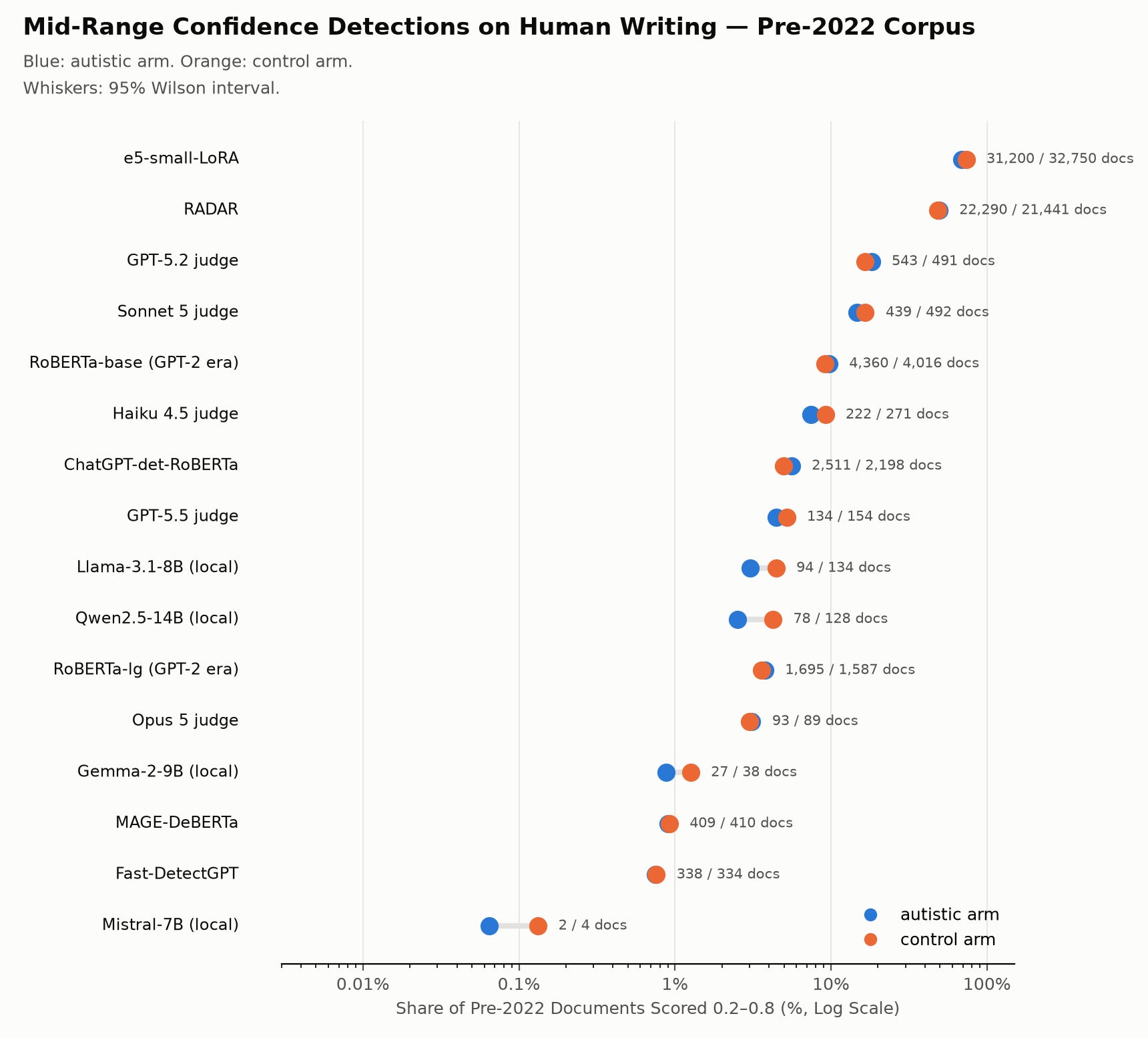
Figure 32 - Unweighted Mid-Range Confidence FPRs on Pre-2022 Autistic and Control Writing
The same data, but composition weighted is shown below:
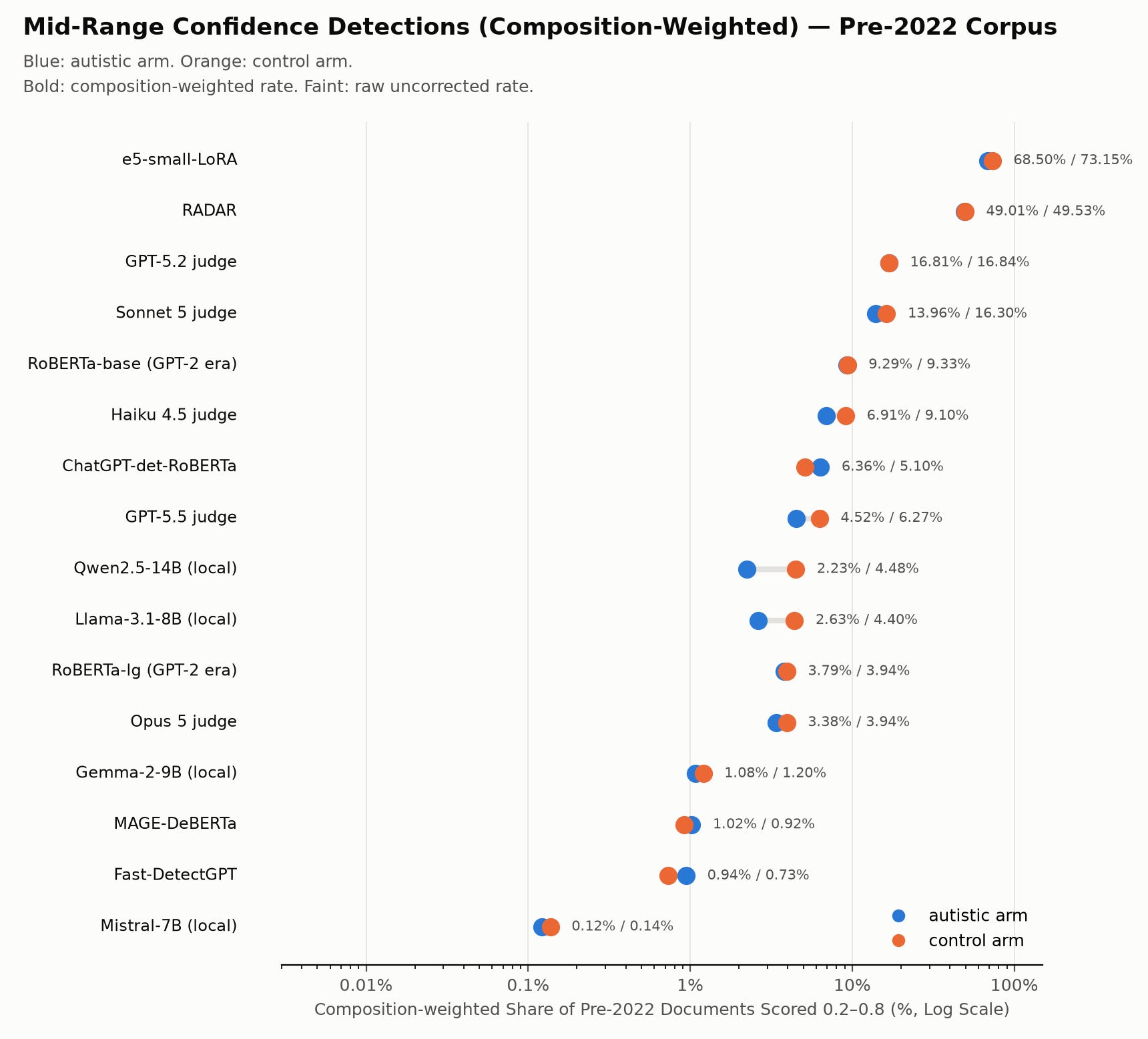
Figure 33 - Weighted Mid-Range Confidence FPRs on Pre-2022 Autistic and Control Writing
Flag rates over confidence intervals are mapped in the figure below. These map pre-2022 False Positive Flagged documents and the confidence level that each was assessed at. This was done to see if there was a meaningful bias against autistic written documents at any level of confidence:
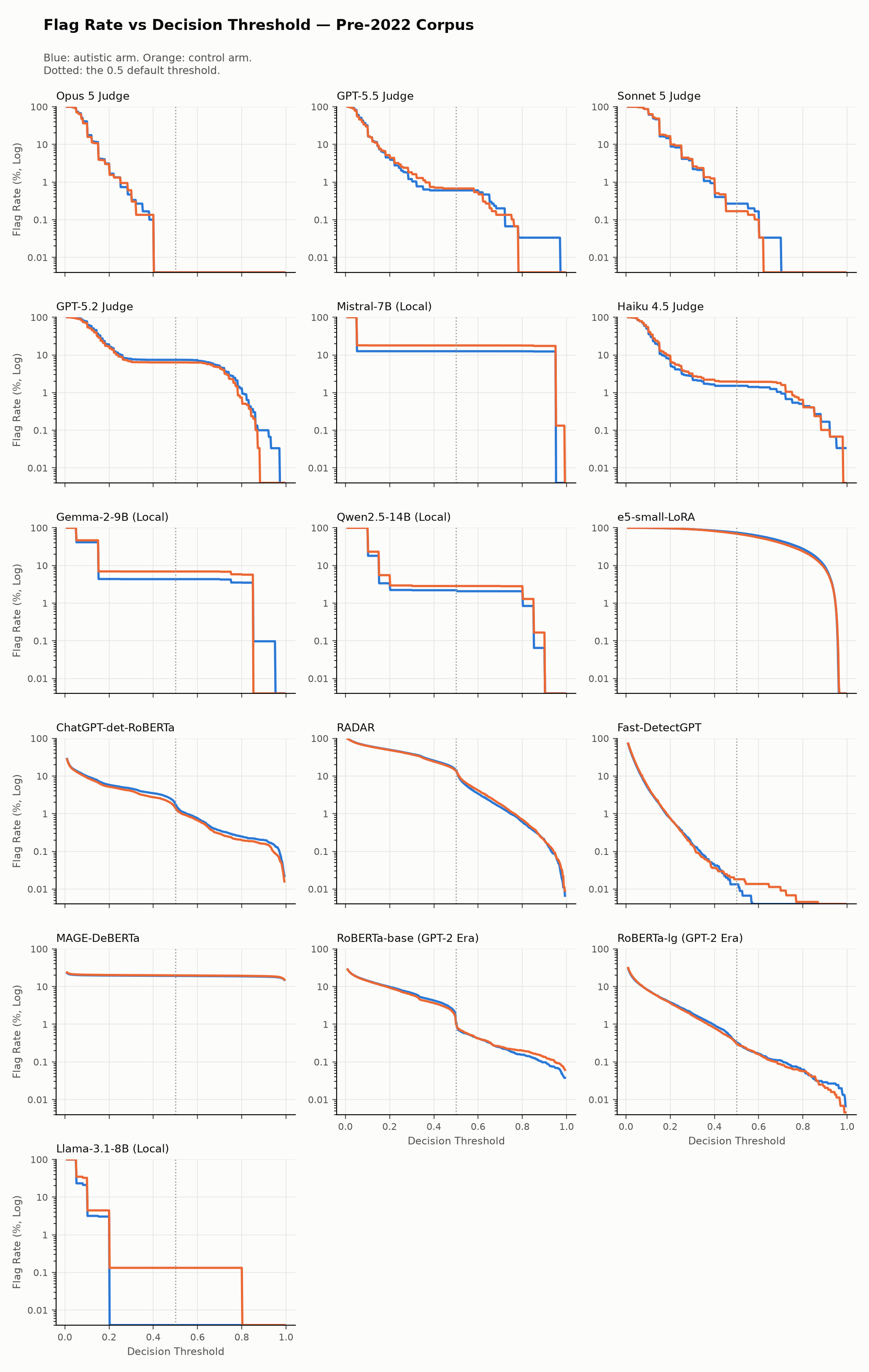
Figure 34 - Model FPRs by Decision Threshold
Another way to analyze this data is with banded confidence interval comparisons. This is shown in the figure below:
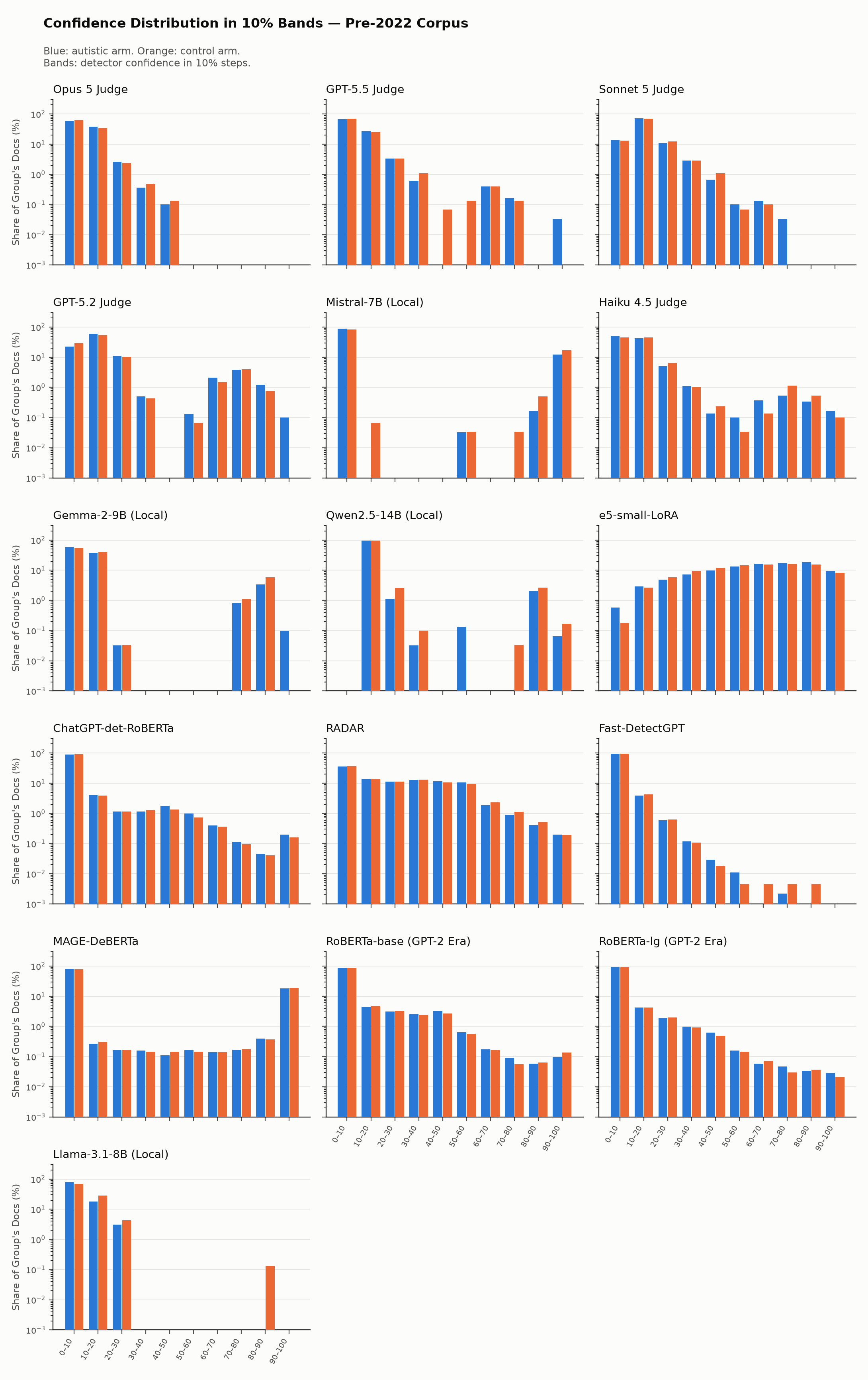
Figure 35 - Pre-2022 False Positives within Mid-Range Confidence Bands
Finally, mid-range AI classification confidence scores were charted over time.
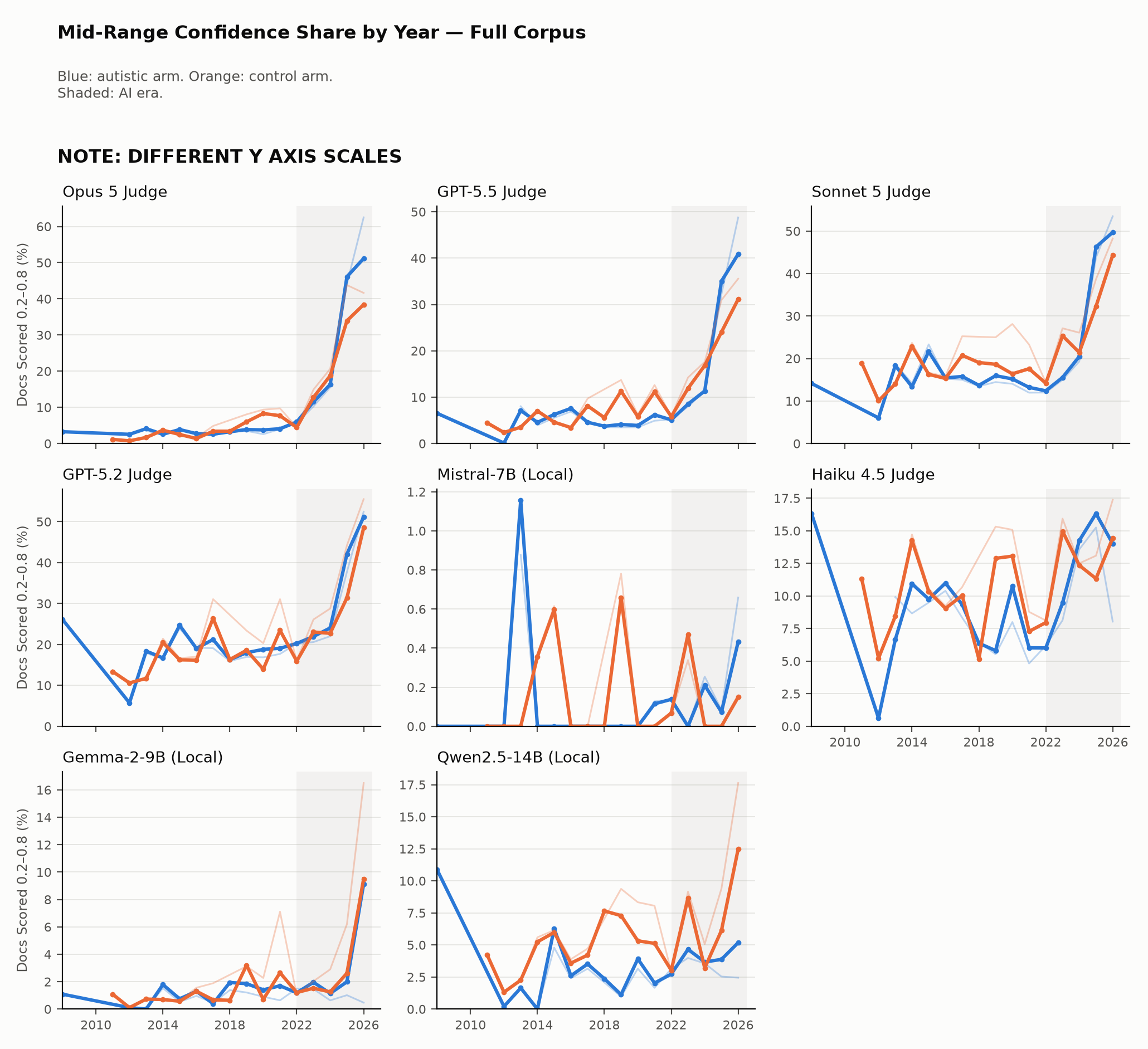
Figure 36 - Pre-2022 False Positives within Mid-Range Confidence Bands Over Time
Validation Against Benchmarks
Many frameworks have published benchmarks against which autistic writing bias can be mapped.
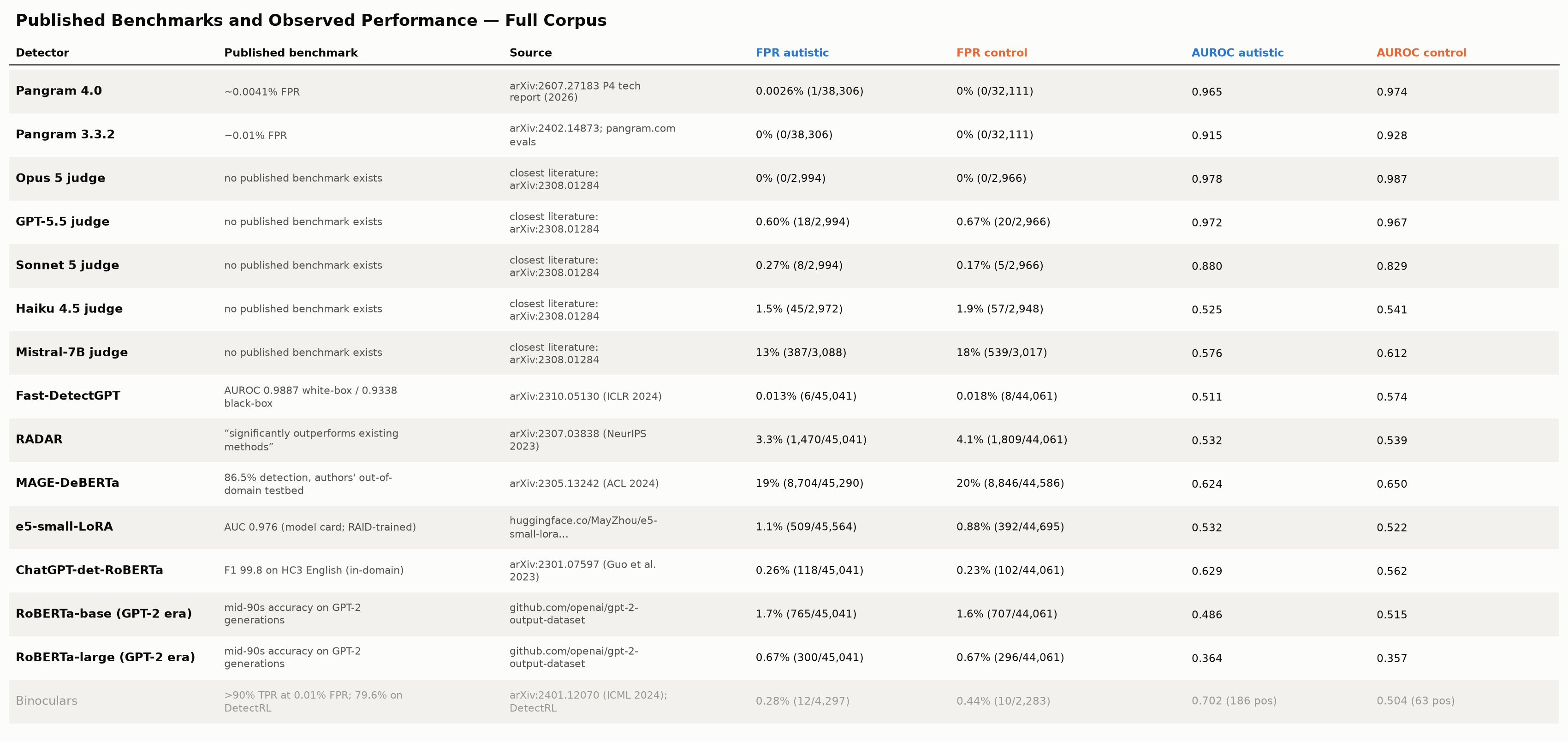
Figure 37 - Pre-2022 False Positives Compared to Benchmarks
Note: Many frameworks were not expected to perform particularly well on this data set so FPR should be taken with caution. For example RoBERTa-base is a GPT-2 Classifier, so is not expected to perform well on anything other than GPT-2 text, and this corpus contains a lot of text that is not GPT-2.
Post-2022 AI Adoption by Sub-Community
Analysis of writing by milieu looks for trends in autistic and control sub-communities to see if AI assistance, usage, and adoption were found in any specific online autistic sub-communities. Autistic writers often disclosed AI usage in writing and reasons differed between genres.
Especially in communities that talk about disability, disability accommodation, and disability justice, the use of AI is often disclosed specifically as a disability accommodation that they use to author their blogs/posts.
Breakdowns of AI usage over time by sub-community is detailed in the figures below. It is notable that this trend captures when lesswrong and rationalist sub-communities started to enforce AI usage guidelines and ban pure AI posts.
A breakdown of AI usage per community as flagged by Pangram 4 (the most reliable detector evaluated) is below
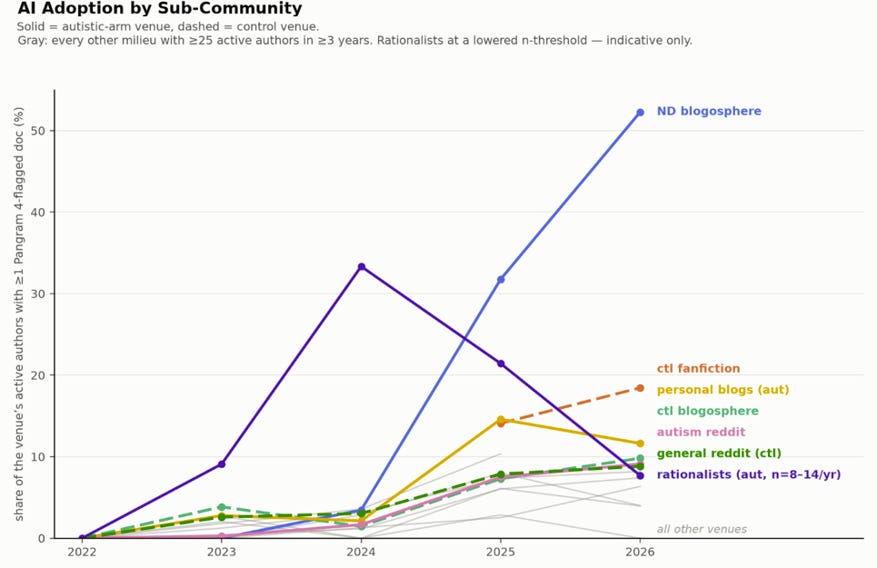
Figure 37 - Percentage of Authors flagged by Sub-Community
The same data, when weighted, flattens out but trends remain the same.
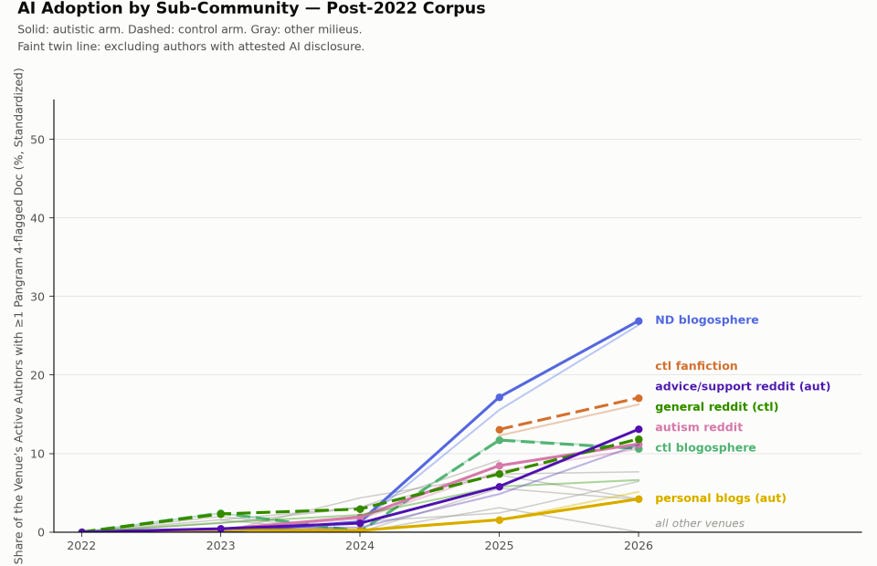
Figure 38 - Percentages of Active Authors that use AI by Sub-community (Weighted)
Data was also mapped by raw document counts to analyze adoption trend lines by document volume.
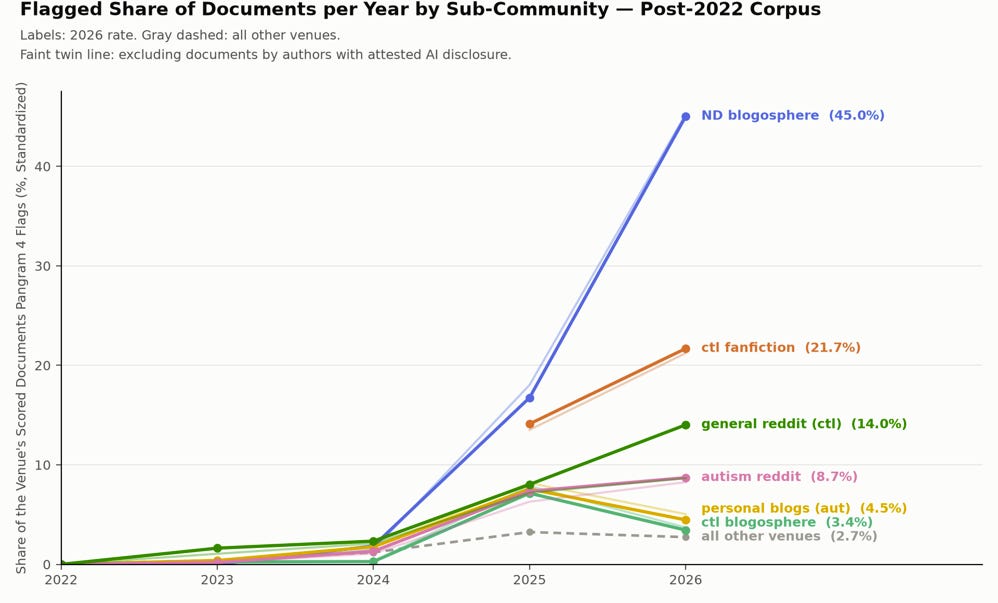
Figure 39 - Percentage of Documents Flagged as AI (Weighted)
Additionally, authors per-sub community with at least 1 segment flagged were mapped.
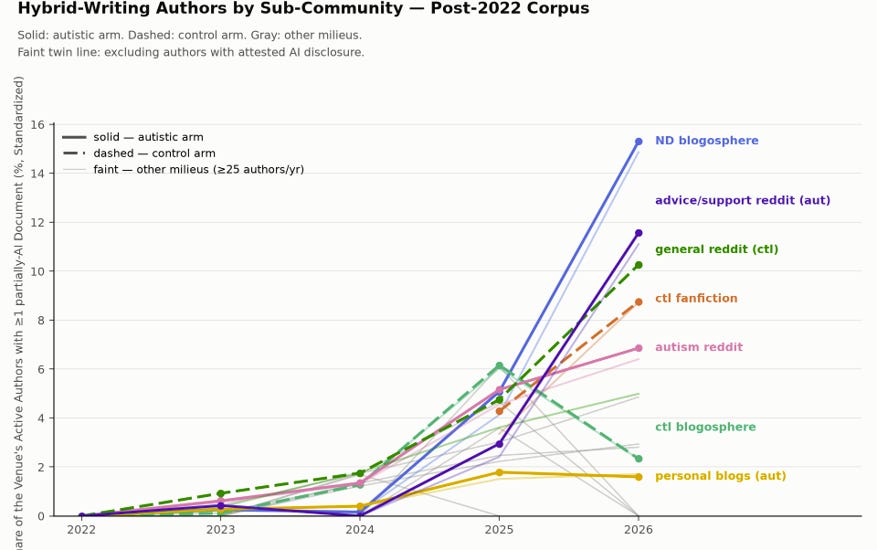
Figure 40 – Authors by Sub-Community with at Least One Partially Flagged AI Document
Finally, the total number of documents where any segment was flagged was also mapped by sub-community.
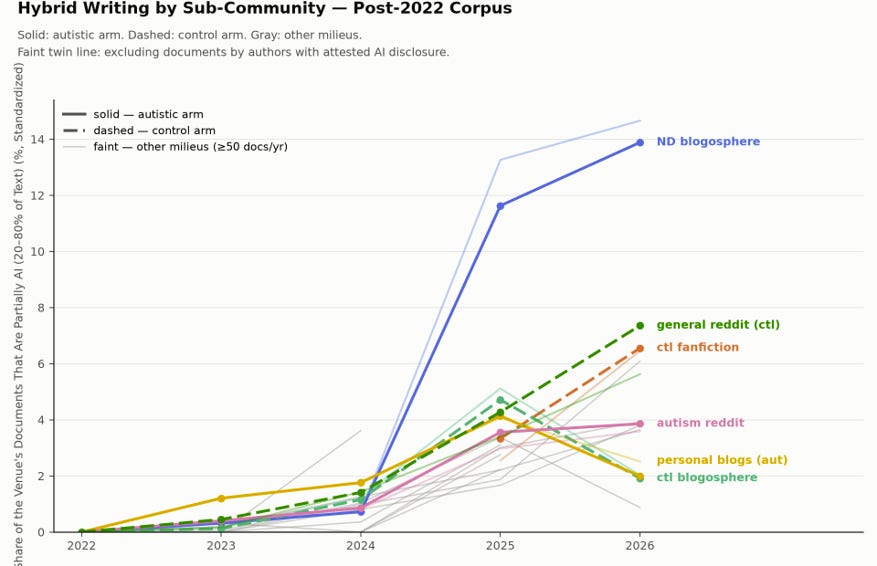
Figure 41 - Documents by Sub-Community with at Least One Partially Flagged AI Document
Chambers & Kelly – Misclassification of Autistic Writing as AI-Generated (2025) - Reanalysis
The testing protocol from the previous Chambers & Kelly study from July 2025 The Misclassification of Autistic Writing as AI-Generated which purported to show meaningful bias against autistic writing was replicated to see if AI detection bias persisted on this data set. The performance graphs of the classifiers that were used for the Chambers & Kelly study are mapped below against the full corpus. The expected curve from a reliable detector (Pangram 4.0) is shown in a faint dashed line to compare performances. Notably, RoBERTa shows no pre-2022/post-2022 detection sensitivity, which indicates very poor reliability.
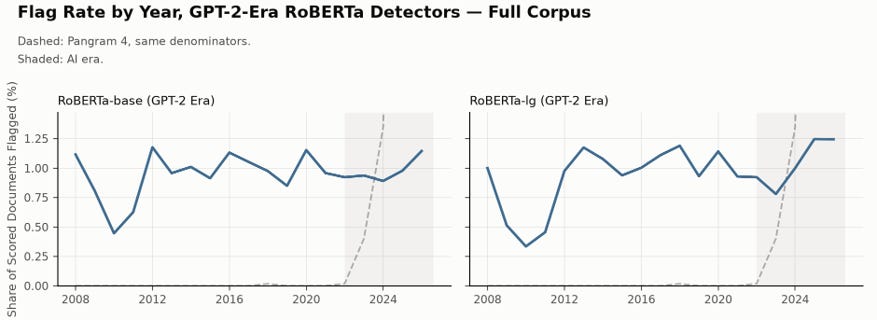
Figure 42 - RoBERTa Performance Detection Curve Combined Autistic and Control Pools
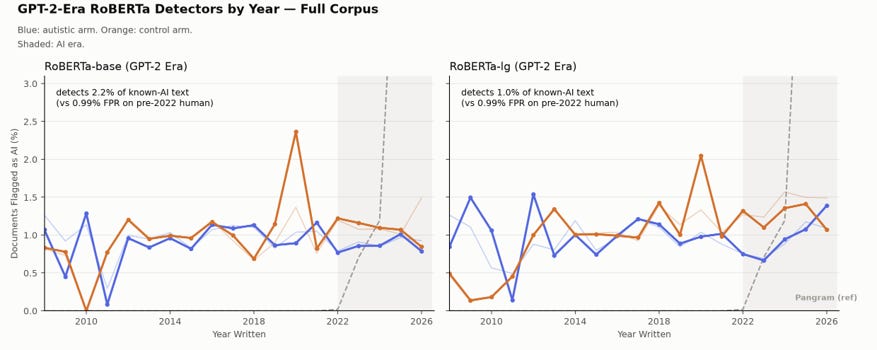
Figure 43 - RoBERTa Performance Detection Curve Split Autistic and Control Pools
The Chambers & Kelly paper truncated posts to 300 characters per post and did not attempt to identify autistic authorship, while posts from this study only considered documents above 500 words. The study protocol was replicated by truncating all posts from a wider variety of confirmed autistic authors from different genres and milieus. Using the same models, protocols, and analysis techniques I was unable to replicate their observed effect. Additionally, windowed versions of the testing were run on untruncated versions of the posts.
Chambers & Kelly’s testing protocol found an autistic FPR of 1.70% and control FPR rate of 1.20%. A replication of their exact protocol on a different data set found a 1.79% autistic FRP and 1.82% control FPR. Testing on RoBERTa-large found an autistic FPR of 0.59% and control FPR of 0.61%. Results from protocol matched experimentation are shown below:
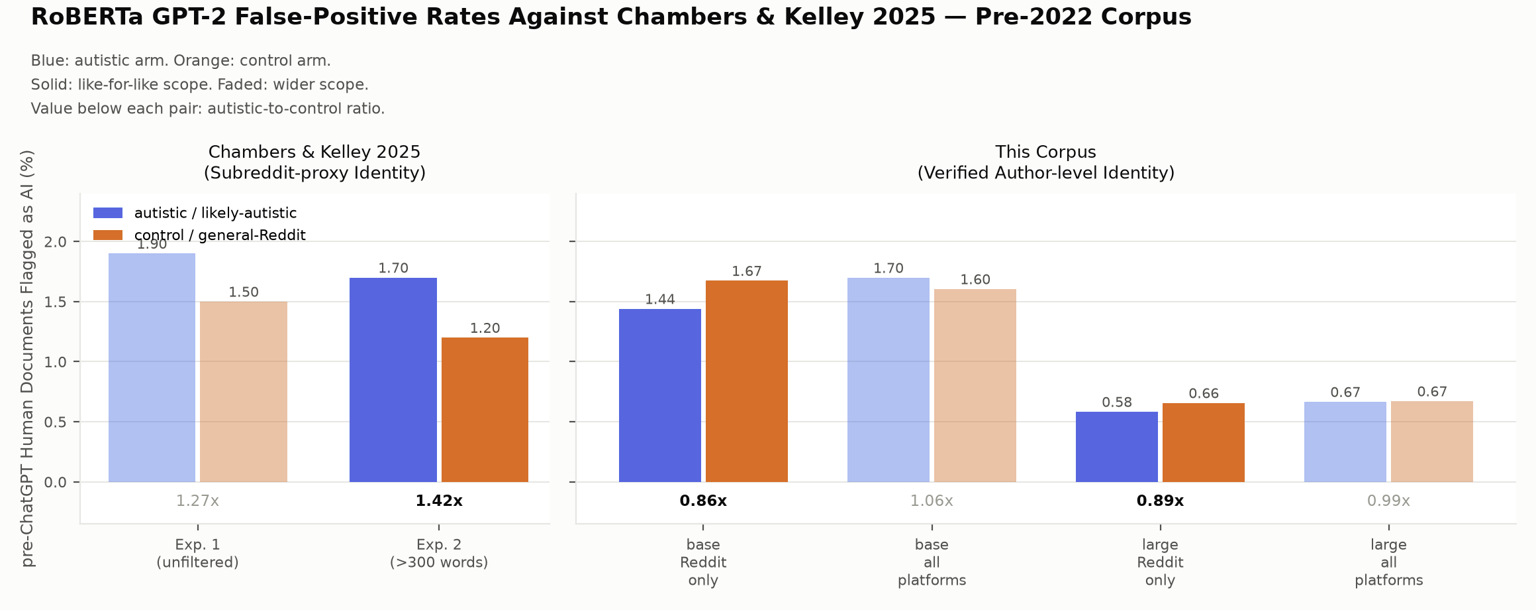
Figure 44 - Protocol Matched Replication of Chambers and Kelly 2025 Study
A wide variety of different methods were employed to attempt to see if changing the window, size, restricting the source to Reddit only, or using one of the available windows scoring methods would change the measure of bias (Detailed in Methodology - Windowing and Piecewise Document Analysis). The below chart shows these experiment results including the Chambers and Kelly experiment for comparison.
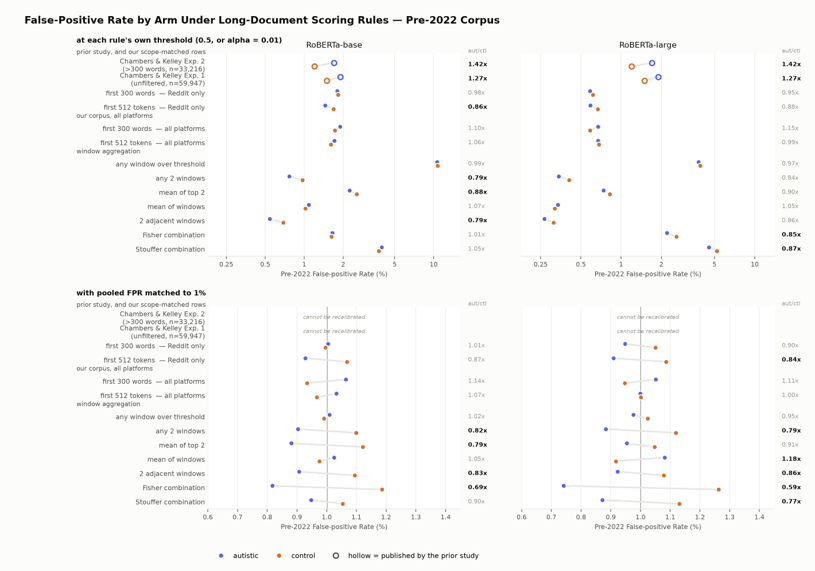
Figure 45 - RoBERTa Results on Pre-2022 Corpus using Multiple Analysis Methods
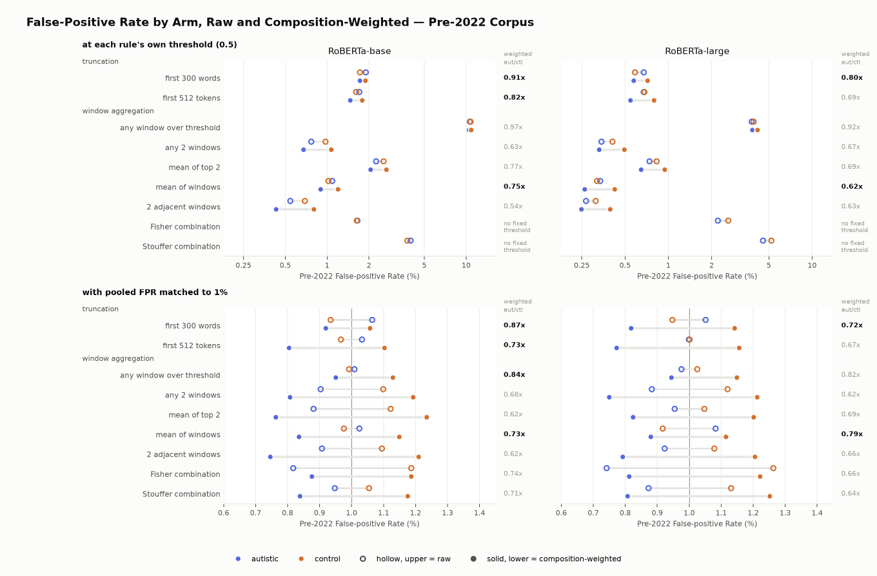
Figure 46 - Composition Weighted RoBERTa Results on Pre-2022 Corpus using Multiple Analysis Methods
Discussion
The AI detectors analyzed in this study showed no appreciable or meaningful bias against autistic writing. Testing established that the claims of AI detectors disproportionately falsely flagging autistic-written documents as AI are unsubstantiated, this is especially true for commercial tools like Pangram. This analysis accounted for full document detections, mixed detections, partial document detections, and mid-range confidence detections. Detectors were nearly twice as likely to have bias to flag control writing as AI than autistic writing. Where bias exists against autistic writing, it is slight and mostly relegated to unreliable detectors. Importantly the commercial detectors that are most likely to be used to actually do this analysis, like Pangram 3.3.2 and 4.0 only falsely flagged 1 document in the entire pre-2022 dataset.
The below figure ranks detectors from most and least reliable and annotates their bias, if bias exists (note: reliability starts to fall off sharply after the first 5 detectors). Reliable detectors show almost no bias, where they do show bias, the bias is slight and in only one instance does this gap fall outside of the margin of error. When a detector does show a bias towards flagging autistic authored documents as AI the gaps are on average smaller and instances are less numerous. Additionally, the detectors that did show autistic bias across comparisons were almost exclusively academic, experiment, or old and deprecated detectors that are unlikely to have ever been used to evaluate autistic writing in any context in which AI detection mattered.
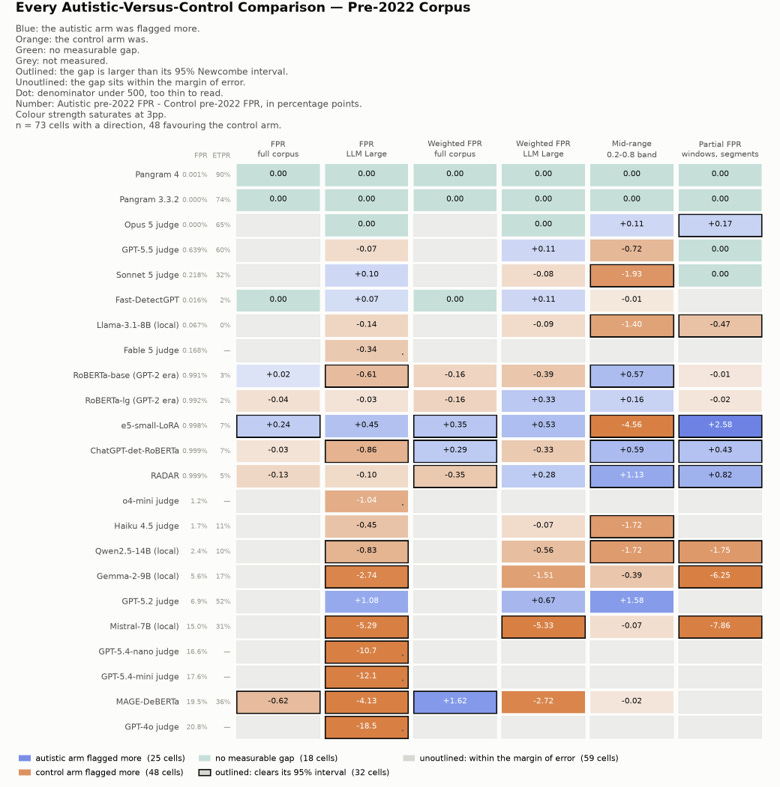
Figure 47 – Every Autistic Vs Control Comparison
The below chart shows bias in a different way that allows you to visualize the number and size of gaps between bias.
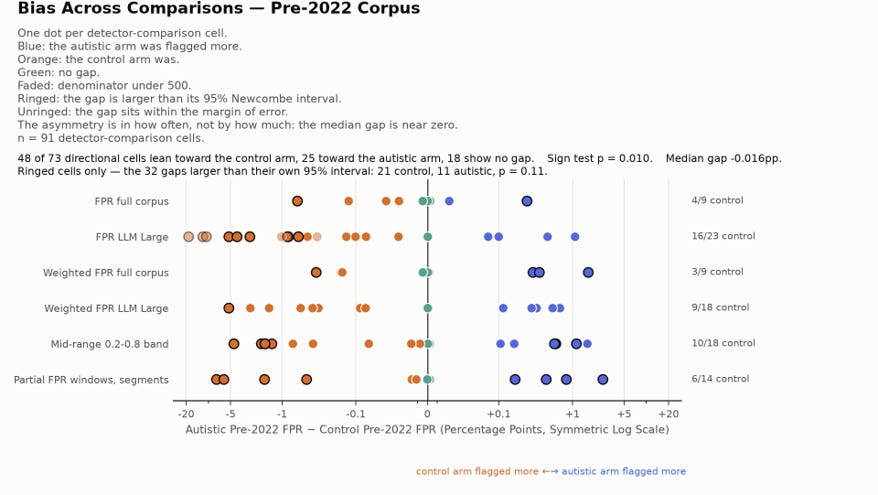
Figure 48 - Bias Weight Across Comparisons
Finally, these biases were mapped across uncertainty gaps. Again, note that autistic gaps are smaller and less numerous.
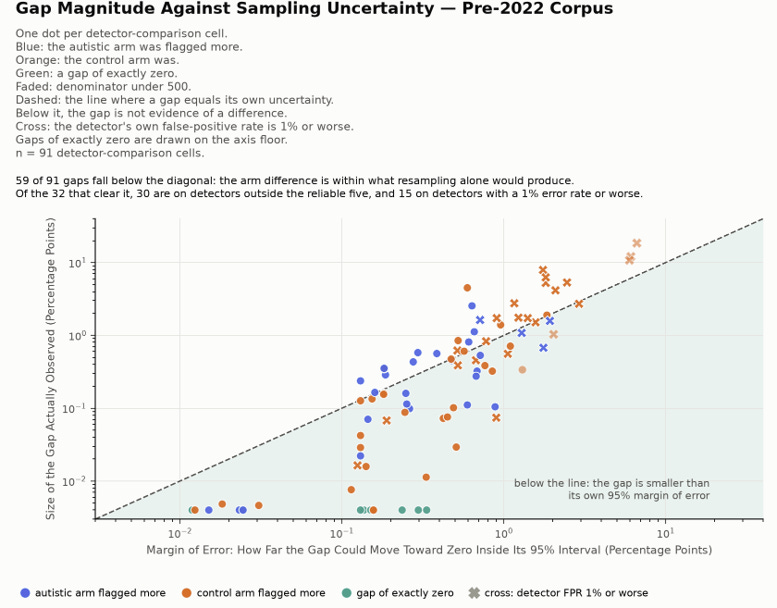
Figure 48 - Weight compared to Margin of Error
For reliable detectors, the results showed that all but two measures were all within the margin of error observed with the exception of two, one which broke favouring autistic writers and one that broke in favour of control writers.
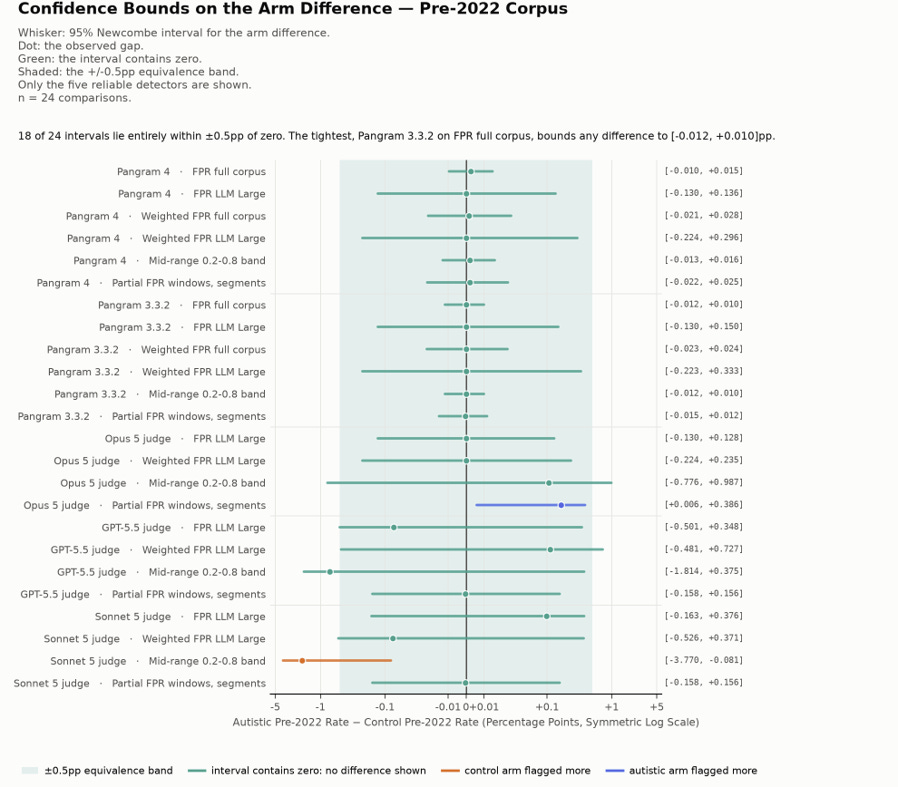
Figure 49 - Most Reliable Autistic Vs Control Arm Comparisons
Looking at the 14 flagged document segments from Pangram 4.0 revealed that 11 of the 14 flagged windows were blobs of formatted and unformatted data and lists, not stylistic prose. For example, the single Pangram 4 pre-2022 detection was a Reddit post detailing combinations of inputs used for the video game Street Fighter V.
This issue was reported to Pangram and they confirmed it was a bug that will be fixed in the next release. If you were to remove listicle content or wait until 4.1, most pre-2022 false positive detection windows for reliable detectors would effectively disappear.
The Chambers & Kelly’s 2025 study that showed a bias against autistic writing used an unreliable detector for their analysis, and even still the unreliable detector showed no appreciable bias against autistic writing when analysis was replicated against a different data set. This study was the only empirical evidence used to back the claim that autistic writing was more likely to be flagged as AI than non-autistic writing.
The lack of bias against autistic writing is to be expected.
LLMs get their distinctive voices and writing styles from two sources:
Training Data
Post-Training
LLMs get their training data from many sources that include writing from across huge swathes of the population, most of whom do not have autism. A statistical engine that will attempt to reconstruct phrasing based on weighted probability distributions is unlikely to pick up on the writing styles of a very small minority of the population. Secondly, autistic people themselves are a very complex heterogeneous population and do not have a unified distinctive writing style. While certain writing styles will be more common in autistic sub-communities, factors like online sub-community culture, tone, politics, localization, community standards, and milieu are likely to heavily skew these styles so that autistic people as a whole will not have a coherent and singular writing style that LLMs will pick up on from training data.
Finally, the distinctive LLM writing style does not come from the collected training data, but from post-training. Post-training is a very intensive process of shaping a model into a specific mode of operation. Post-training is designed to make the model usable and accessible for the majority of the population. It is unlikely that post-training would be accidentally directed into resembling the writing of an autistic person in a specific sub-community. Model fine tuning and adjusting is done for mass consumption and usability and is unlikely to be trained to have the specific distinctive features that you might find from an autistic sub-community.
The distinctives that exist in different autistic sub-community writing, if they exist at all, are likely to be flattened and smoothed over in both the training and post-training phase. The results from this experiment show that this is very likely the case.
Conclusion
Individuals and institutions that are concerned about AI text detection discriminating against autistic people can rest assured that effective AI detection software will show no bias against autistic writing. Unreliable software will also not show bias, but the rates of false and true positives make their usage generally unadvisable.
False positives, incorrect attribution, and false negatives are an inevitable part of the usage of any detection software. They will happen and can never be fully mitigated due to the nature of detection software and LLM writing. This paper has very conclusively shown that even though false positives and false negatives will happen, they will not happen because you have autism or write like an autistic person. If you are autistic and your writing is falsely flagged as AI writing, it is not because you are autistic, it is for some other reason(s).
Autistic people are a marginalized sub-group, and making unsubstantiated claims about discrimination has tangible negative effects on the community. AI detection software is an inevitability in today’s AI writing-saturated world. AI detection software has been rolled out on platforms like Substack and is seeing increased use in academia. If AI detection software was unfairly biased against autistic writers, it would be a serious matter of justice and a cause of great concern for autistic people and the institutions that use the software to judge autistic writing. Luckily, there is no discernible bias against autistic people in AI detection software, especially commercial models.
The concerns about AI software being unfairly biased against autistic writing are not founded on good evidence. This claim was assessed by using 24 different open-source and commercial AI detection/classification algorithms on samples of documents pulled from a pool of 143,758 documents from autistic authors and non-autistic control authors. Writing was taken from a variety of different websites covering different writing types, styles, topics, and genres. Analysis of the data definitively found that there was no meaningful bias against autistic authors across any of the models.
Future Work
Fable as Judge – Get funding to run fable as judge
Greatly expand LLM as judge with additional instruction/context cues and explanations for how to detect AI writing
Test different prompts/prompting methods on LLM as judge
Expand LLM as judge data set from LLM Large to the full corpus
Expand data set to include autistic and control student writing pre-2022 and post-2022
Expand representative control data set post-2022
Addendum
During testing I found a bug in Pangram’s Dashboard that merits discussion but has nothing to do with the performance or bias.
Just for fun, I uploaded a draft of this report to Pangram. There one section of this report that was written by AI which are the disclosed Fable prompts. There is one section of this draft report that should have been flagged, which is the section in methodology containing the LLM as judge prompts. The 21 other sections that were flagged by Pangram 4.0 were those that contained graphs, lists, and formatted tables. These were all created with matplotlib. Claude code was used to write the python matplotlib code to generate the templates and skeletons for the diagrams, but I wrote the titles, subtitles, and axis labels. Below were the results from uploading a draft of this report. Notably, no sections of prose that I wrote were flagged as AI written, only formatted data, graphs, and charts.

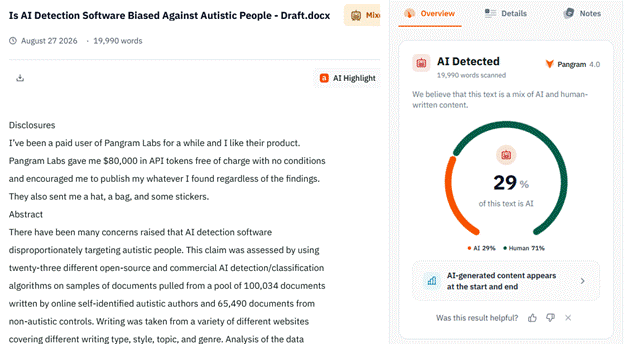
Further analysis and confirmation from the Pangram team confirmed that this was a bug an unintended behaviour. This is due to a pre-processing bug in the OCR algorithms used by the Pangram Labs dashboard for PDFs and Word Documents. Submitting these by chrome extension, Substack, feed scanner, and copy/pasting into the dashboard all resulted in 100% human written. Pangram has been made aware of this bug and has plans to fix it in the near future, but for now, if you upload a word document or PDF to the Pangram Dashboard, there is a fairly good chance it will flag your diagrams as AI written because the OCR text extraction for images will pull out junk/garbage data.
Note that some of them from substack specifically mention Pangram as having autistic bias, this will be important later
In b4 Neurodiversity bloggers are anathematized
Out of interest, why is it that you aren't looking to get this published in a journal yourself? This feels important and timely, the quality is good (to my eyes) and publication would reflect the effort you have expended.